
This year, strength training was the third most popular workout among users of ClassPass, a subscription-based fitness app, and the American College of Sports Medicine expects it to be one of the top 10 workout trends for 2025. If you’re toying with giving it a try, here’s some helpful info.
Why Lift Weights?
Strength or weight training — not to be confused with weightlifting, a competitive sport in which people vie to heave the most weight — has many health benefits, including strengthening bones and muscles, improving joint health, managing weight, and helping balance and coordination.
“Also, it mentally strengthens you,” says Crissy Santillano, head coach at CrossFit Herndon, a strength and conditioning gym. “The stronger I became, the more confident I became as an individual, as a woman.”
Who Should Lift Weights?
“Everyone can benefit,” says Santillano. “The degree of intensity for a 20-year-old and a 60-year-old might look different, but they’re still getting the same benefit,” she says.
Traditionally a male-dominated workout, fitness trainer Justin Case says women are gaining interest in weight training. Case says that when he opened Underground Athlete in Fairfax in 2008, about 70 percent of his clients were men. “Then slowly it went to 50/50, and now we’re approaching 70 percent women and 30 percent men,” says Case, adding that women ages 35-55 are a big driver of that.
Rookie Mistakes to Avoid
It’s important to know your body when you’re starting any exercise program, says Case, a certified strength and conditioning specialist and former Marine. “If your arm doesn’t go over your head naturally without pain, you probably shouldn’t be doing [shoulder presses],” he says. “There’s a lot of variations that could be done that are more appropriate.”
Similarly, don’t walk in on your first day and expect to bench press 250 pounds or even complete a pull-up. Be realistic, Santillano adds. “When you start this, we want you going into it with the idea of this is going to be a lifestyle for you,” she says. “It’s not just a quick fix, and it’s not going to happen fast.”
Exercises for Beginners
Weight training has three main elements, Case says: exercise selection, volume (the amount of work you perform during a session), and intensity. These elements might be different for each person, but there are some foundational moves, many of which mimic common activities, that he recommends for everyone.
One is squatting. “You’re going to sit down on a couch, a chair, a toilet, so we need to teach people how to squat,” Case says. “There are so many variations.”
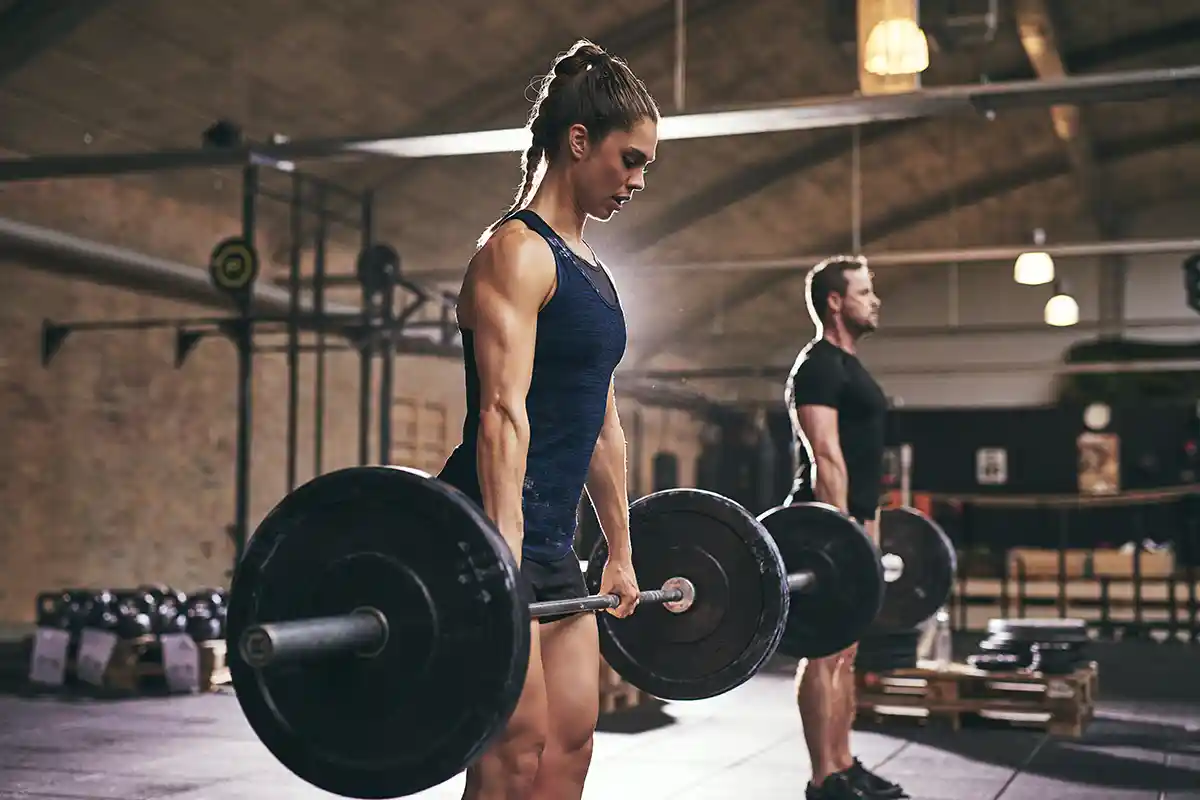
Another is a hinge movement, such as a deadlift. To do it, stand with your feet hip-width apart, hold a weight in each hand (or a barbell in both hands), hinge forward with a neutral spine to lower the weight and stand straight again. This works the glutes, hamstrings, core and back.
Other movements include an upper-body horizontal push such as a push-up, a horizontal pull like a row, and single-leg lunges.
Both experts recommend weight training two to three times a week to start, and then incorporating cardio activity (such as walking) or stretching on other days. This advice aligns with the federal Physical Activity Guidelines for Americans prepared by the Office of Disease Prevention and Health Promotion.
Bottom Line
“You don’t have to be fit to start doing this; any stage you’re at is a good time to get started,” Santillano says. “It’s a lot of fun. And training should feel fun. It shouldn’t always feel like you’re destroying your body. What you do in the gym should improve your quality of life outside of the gym.”
Feature image, stock.adobe.com
For more stories like this, subscribe to Northern Virginia Magazine’s Wellness newsletter.