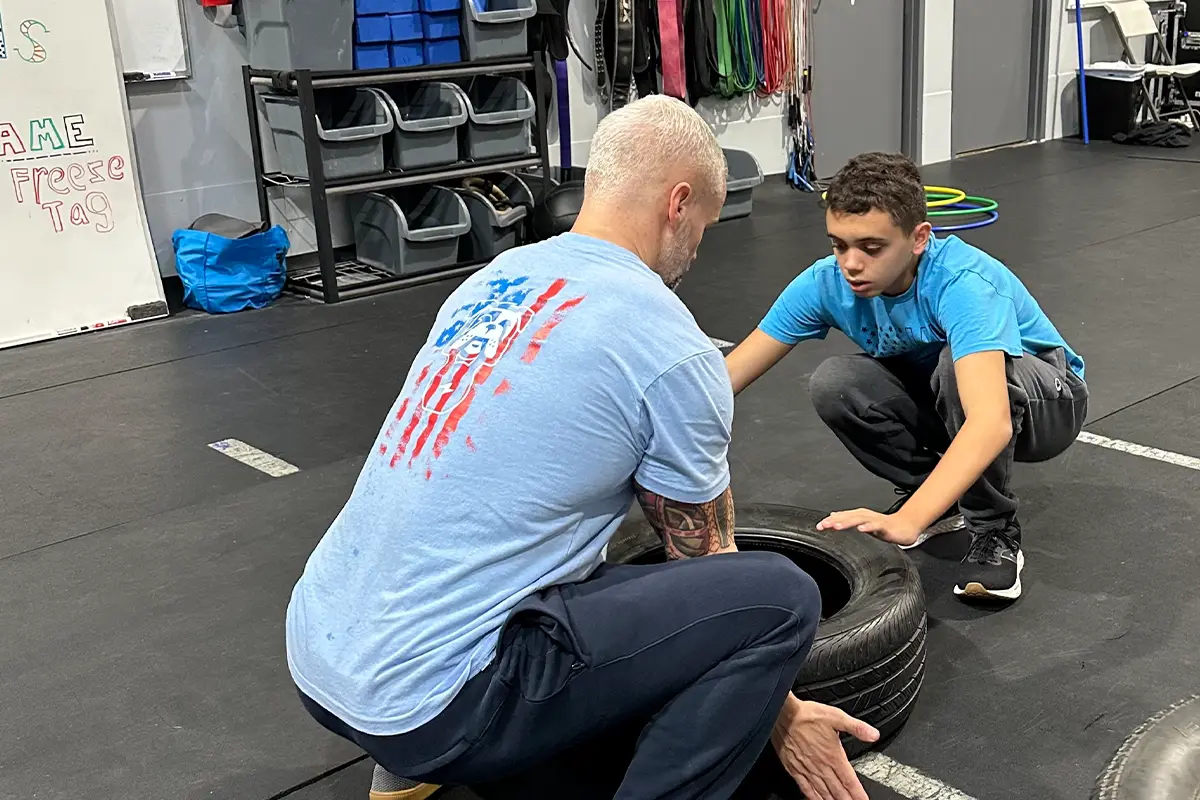
Chad Ciri, owner of CrossFit Burke, is used to moving heavy weights. But for a while, offering a uniquely abled fitness class for neurodivergent teenagers felt like too big a lift. “It took me about two years to build up the courage to be able to just try it,” says Ciri, whose son is on the autism spectrum. “For too long, I held on to the mentality of ‘it’s got to be perfect. I have to be a therapist.’ Eventually, I just took the mindset of, ‘Nope. I’ve just got to provide a space and be totally open to how this goes.’”
Uniquely Abled Fitness Classes
He took the leap in spring 2024, when the box — the name for CrossFit gyms — became one of six Uniquely Abled Fitness Chapters in the country. Today, the adaptive class, offered every Saturday, is “the best 45 minutes of my week,” Ciri says. In fact, he recently added another one on Thursday afternoons.
It’s a hit with participants, too. Starting with a handful of CrossFitters, the class now has 16 enrolled.
Fairfax resident Hunter Fields is a devotee. He’s been attending the adaptive class weekly since May 2024. “I think it is so much fun,” says Fields, 19. “I like to lift heavy weights.”
And that’s the idea. Sessions use the same principles of any CrossFit workout: Perform functional movements at high intensity. They’re built on nine foundational movements, such as the shoulder press and deadlift, but there’s also a “workout of the day,” or WOD, that varies.
Sessions start with participants introducing themselves and answering a question of the day. “I think that’s a really important component of the class because it increases those social engagement opportunities … that individuals with neurodivergent minds have struggles with,” says Drew Gatto, a CrossFit coach and adaptive PE teacher for Fairfax County Public Schools.
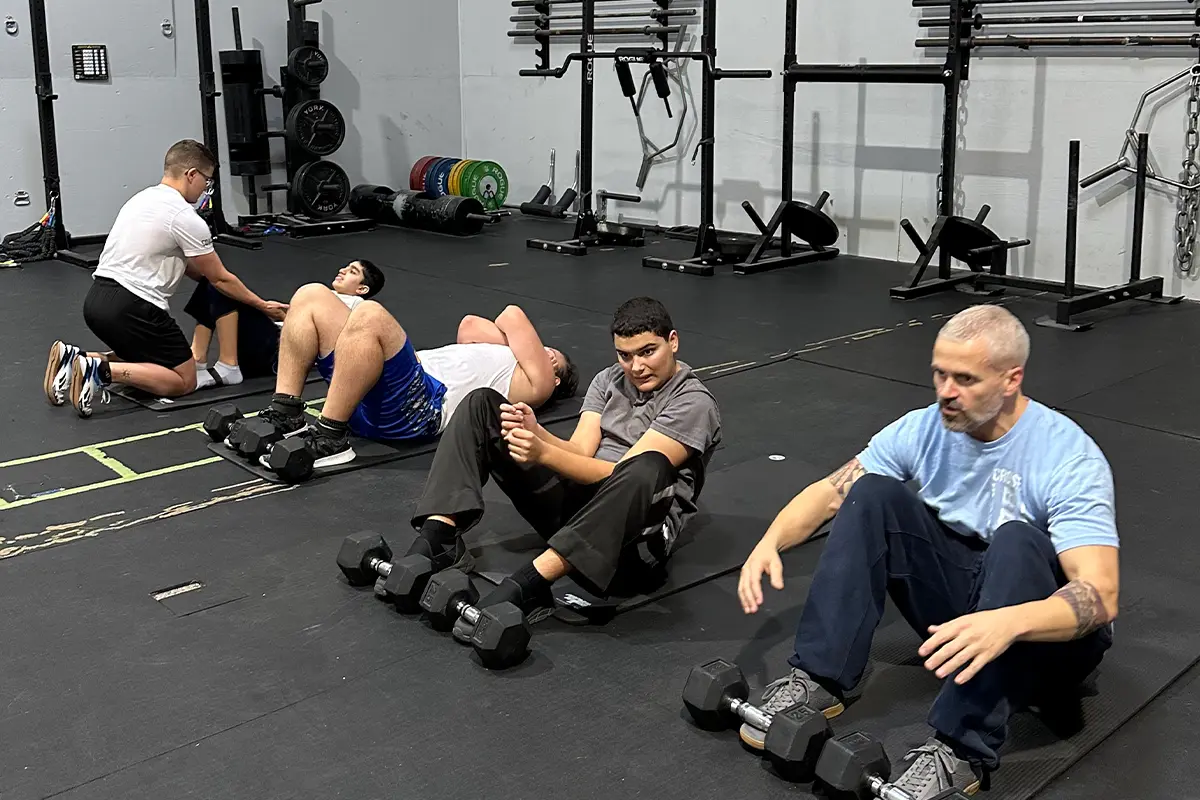
Afterward, they do a warm-up to increase heart rates before moving into skill work. Gatto sees progress: Participants used to do air squats without additional weight, and now they hold barbells, dumbbells, and kettlebells.
Modifying Uniquely Abled Workouts
The main difference between the adaptive class and sessions for neurotypical CrossFitters is a need to be more flexible, says Chase Goodfellow, another coach.
“Any of us can take any workout from any class and make it fit these adaptive athletes,” Goodfellow says. “What is challenging about this class in particular is we have to come up with scaling options. Sometimes it just doesn’t click in the way we expect it to, and so it takes a lot more adaptability on our end as far as modifying a workout to fit their needs.”
Gatto says that often means using different prompts. “A lot of kids who are neurodivergent require visuals and verbal cues, so we use visuals on the ground for them to put their feet on, so they know where their feet need to go,” for example, he says. “We use tactile cues, like a medicine ball for squats so they know how deep to go. We get creative and meet them where they’re at.”
The benefits CrossFitters get are the same — more strength, endurance, cardiovascular fitness, and flexibility.
“I’ve seen a lot of progress in them in the school setting because of what they’re doing here,” Gatto says. “One of the kids that I work with in this program at the beginning of the year was unable to do basic locomotor skills, like sliding, galloping, skipping. But because of what they’re doing here — bilateral movement, multi-step movements — they’re able to now do those locomotive skills in school. They’re not working on sliding and galloping and skipping here. They’re working on different movements. But it’s translated into that because they’re training both sides of their brain. They’re moving their body in ways they’ve never been able to move them before.”
Currently, the class is open to kids ages 12 to 18. Although, “I don’t know if we necessarily ever have a cap on age,” Ciri says, adding that demand is growing for a class for neurodivergent adults.
Ultimately, he’s glad he got out of his own head to launch the youth class. “What we realized is if you have the passion and the patience, everything else you figure out,” Ciri says. “It’s been a good lesson to be open, be kind and passionate. And everything else really does follow.”
Northern Virginia is home to many adaptive programs, most sport-specific.
Other adaptive programs include:
- Aceing Autism: tennis
- Adapted Sports at the Pozez JCC of Northern Virginia: basketball and soccer
- Arlington County SPIRIT Club: gymnastics, yoga, and Zumba, and others
- Cloverleaf Equine Center: horseback riding
- Fairfax County Adapted Recreation Programs: soccer and tae kwon do
- LCF Kids: biking and others
- Loudoun County Adaptive Recreation: bowling and others
- Miracle League of Prince William County: baseball
- NoVa Cool Cats Special Hockey: ice hockey
- Special Olympics: cheerleading, cross country skiing and snowshoeing, pickleball, and others
- SPIRIT Equestrian: horseback riding
Feature image of Chad Ciri and his son courtesy CrossFit Burke