Rebecca Kaltman, MD, is the Executive Director of the Inova Saville Cancer Screening and Prevention Center. A breast medical oncologist by training, Dr. Kaltman leads the Inova Saville Center, a facility dedicated to cancer prevention and early detection.
You probably know someone whose life has been affected by breast cancer. With more than 300,000 new cases of invasive breast cancer diagnosed each year, we all do. But you may be surprised – and encouraged – to know that if breast cancer is caught in its earliest stages, the five-year survival rate is 99 percent, according to the National Breast Cancer Foundation. Early detection is critical. And thanks to recent innovations in breast cancer detection and diagnosis, our ability to catch breast cancer early, and in some cases even predict its future development, has never been greater.
The Promise of AI in Breast Cancer Care
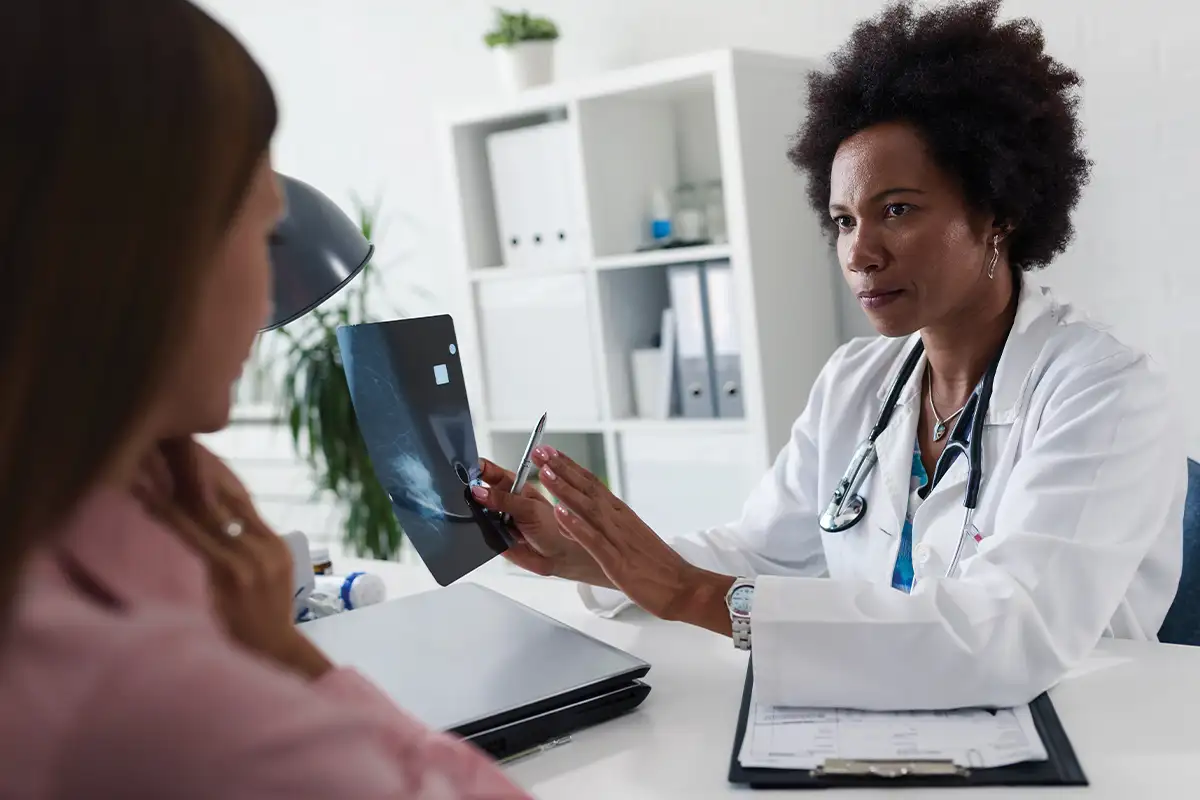
For years, health care providers across the country have been using artificial intelligence (AI) tools. For example, providers can use AI to automatically document a note in a patient’s chart or (with the patient’s permission) take detailed notes during a visit. In terms of breast cancer screening, radiologists routinely use computer-aided tools, in addition to their own reading of the images, to evaluate the mammogram and compare it to the patient’s previous mammogram images.
Now, the field of breast cancer prevention is beginning to use AI to help providers determine a patient’s risk of developing breast cancer in the future. This approach, called “risk stratification,” aims to find out who is at higher risk of developing breast cancer. With that information, health care providers can recommend additional screening for people at higher risk – ultimately increasing the chance of catching breast cancer early if it does develop.
The benefit of risk stratification is that it personalizes an individual’s breast cancer screening schedule, rather than settling for the broad, age-based guidelines published by the American Cancer Society and the U.S. Preventive Services Task Force. Within the next five to 10 years, we hope to see AI tools for breast cancer risk stratification become mainstream.
Spotlight on MirAI
One very exciting tool that we’re evaluating at Inova is called MirAI. It’s an MIT-developed algorithm that uses AI specifically for breast cancer risk prediction.
Generally, for risk stratification in the clinic, we use tools that are based on patients’ clinical information such as whether anyone in their family has had breast cancer, whether they have had children, whether they are pre- or postmenopausal, how dense their breasts are, and other factors. The most common risk stratification tool is called the Tyrer-Cuzick risk model, which uses this clinical information to estimate a woman’s lifetime risk of developing breast cancer.
MirAI is different. It looks at the mammogram alone, using a machine-learning algorithm, and predicts a woman’s five-year risk of developing breast cancer.
By recognizing patterns in the breast tissue that we can’t see with the naked eye, this tool identifies breast tissue patterns that are likely to develop into breast cancer. It also has the potential to identify the area in the breast where the cancer could develop. Studies have demonstrated that without any of the clinical information we normally use – without knowing the patient’s age, family history or any other details – MirAI predicts breast cancer risk better than any other model currently available.
Inova is currently engaging in a research study using MirAI. Our goal is to:
- Test whether we can reproduce the results of earlier studies
- Evaluate how that information could be used to help patients
- Look at whether this added information could change screening recommendations for individual patients
Other Promising Uses of AI to Predict Breast Cancer Risk
Another leap forward that AI can help us take is its ability to scan a patient’s complete medical record and highlight the most relevant clinical details to help predict that person’s risk of developing breast cancer. This concept has already been tested to predict colorectal and pancreatic cancer risk, among others, and we could also use it for breast cancer risk prediction.
Combine a fuller picture of clinical information using AI with the capabilities of MirAI, and we have a much more powerful way of predicting breast cancer risk. And both of these tools can be used with information and images we already have. They do not require any additional input from the patient or the provider.
Historically, women with dense breast tissue face more challenges because their screening mammograms are not as effective in detecting breast cancer as they are in women who do not have dense breast tissue. In the future, AI tools like MirAI may be able to help by enhancing the readability of a mammogram in a woman with dense breasts. We are continuing to evaluate and research other ways of imaging that might be more effective for women with dense breast tissue.
The Future of Breast Cancer Risk Prediction
We are entering a promising time, thanks to innovations and advancements in AI and other technologies. We also know that genetics can play a role in breast cancer risk, and in the future, I hope we can bring genomic data (based on an individual’s genetic information, or genome) into the mix. Combining these three types of information – clinical information, information from a patient’s mammogram, and genomic information – into one algorithm could enable providers to pinpoint an individual’s risk.
With a specific, individualized risk score, we could customize the individual’s screening and risk reduction plan to include the type of imaging recommended, its frequency and the ideal age to start screening. For those at significantly increased risk we could employ personalized approaches to medication and surgical options. We are already doing this type of risk assessment now. AI will enable these tools to be that much more precise. The goal of this personalized screening plan would be to catch breast cancer early or even prevent it, without subjecting patients to lots of tests and screening that they don’t need.
In the long run, I hope to see this technology, and others like it, reducing health disparities and increasing equity. More sophisticated prediction models can help us focus resources in the right places, to make sure we’re not overscreening people who probably don’t need it, and not underscreening people who do.
Learn more about the Inova Saville Cancer Screening and Prevention Center.
Feature image, stock.adobe.com