This is part of our August cover story, which also highlights 11 unsolved cold cases and includes information about advancements in DNA technologies and the use of forensics to solve a decades-long cold case.
It’s natural to want stories to have endings, so the photo gallery on the seventh floor of the Fairfax County Police Department (FCPD) headquarters is a bit unnerving. Each of the 101 framed images represents a homicide or unidentified person case that, after years of investigation, went unsolved. Gone but not forgotten, these are the faces of FCPD’s cold cases.
A Wall of Sorrow and Hope
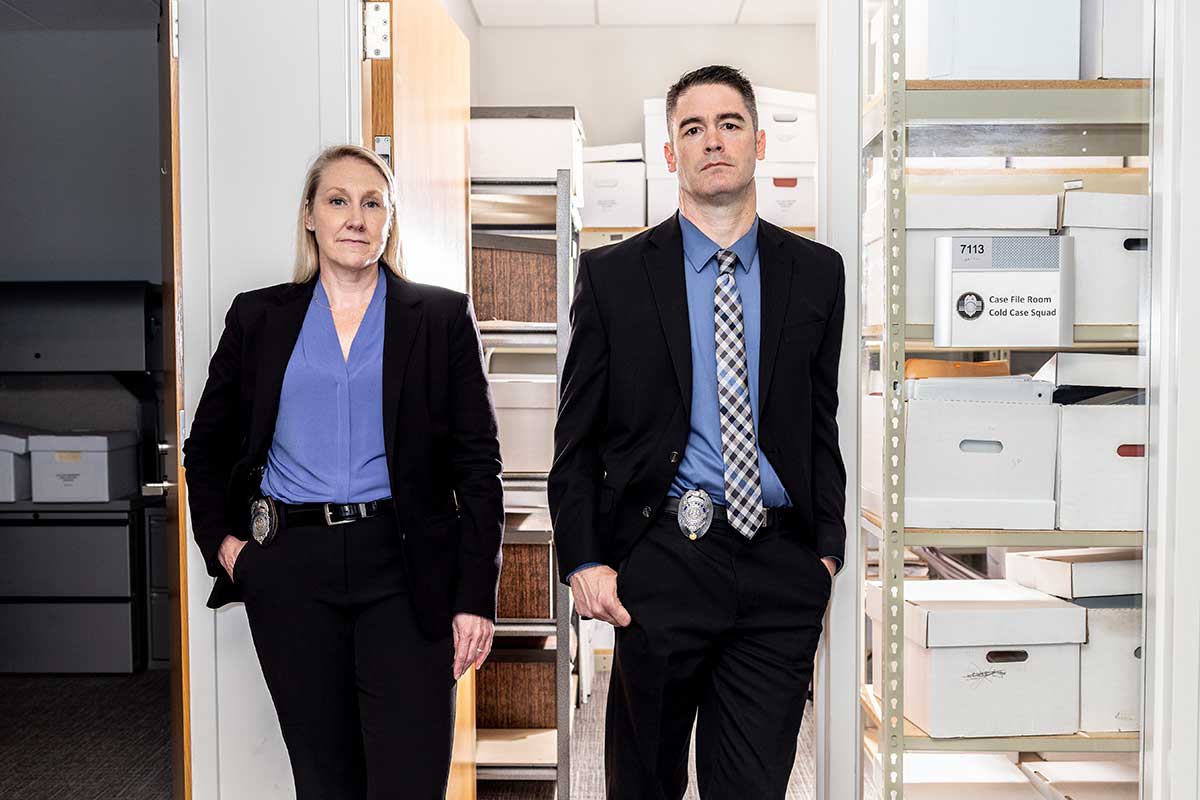
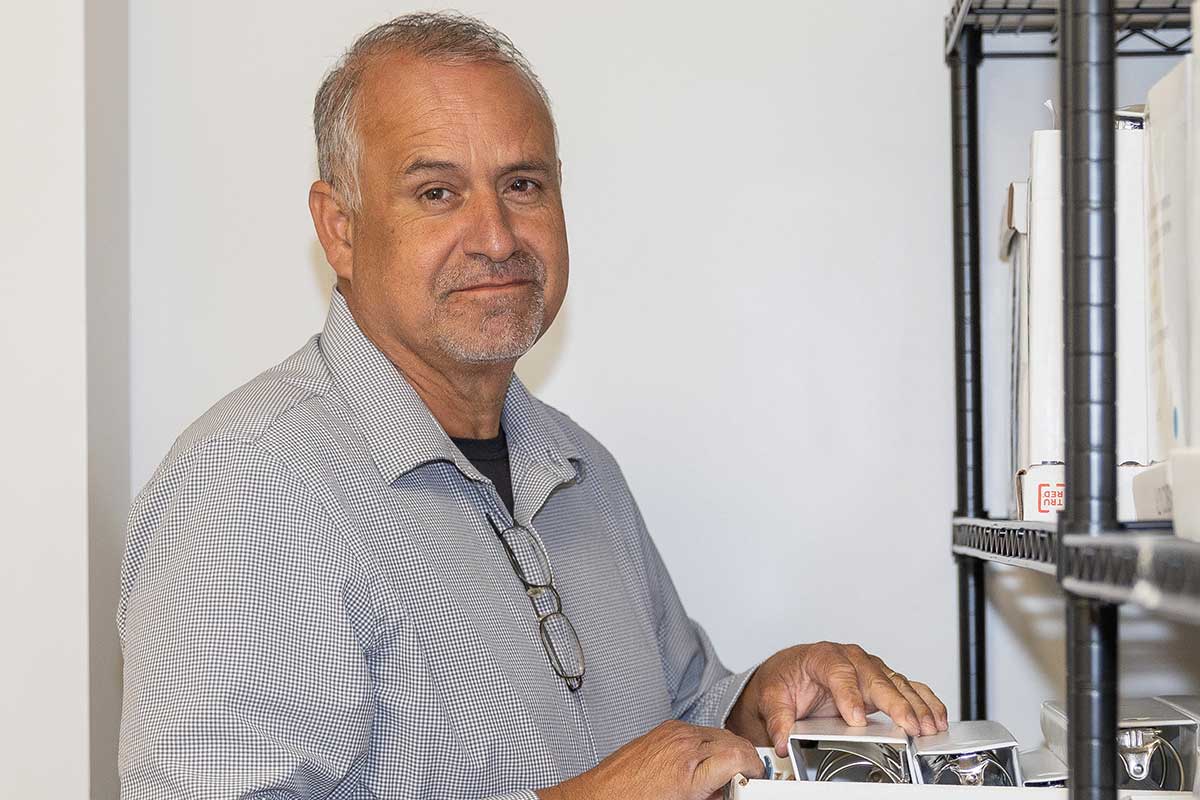
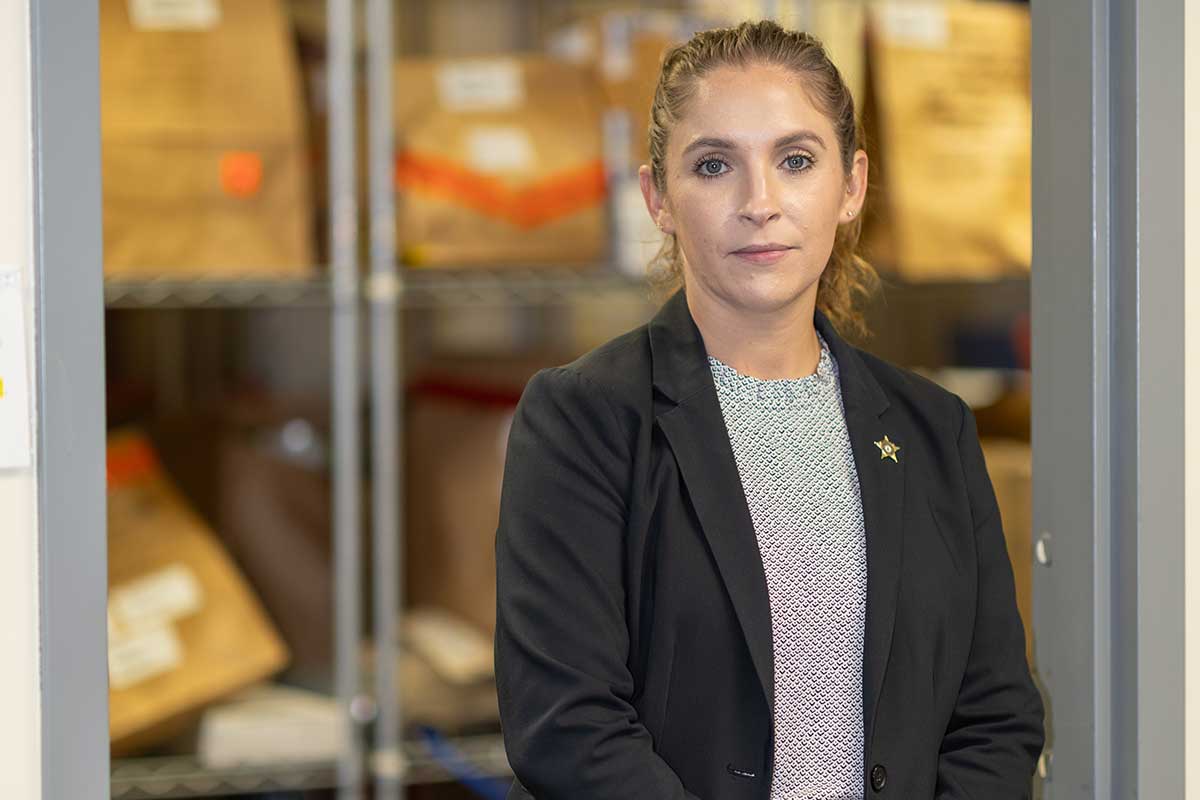
FCPD Cold Case Detectives Jon Long and Melissa Wallace reflect on the photos often. From grainy newspaper images to smiling school portraits, the faces show a range of decades, ages, skin colors, and expressions. A few are just silhouettes. Their only commonalities: The person or persons responsible for their deaths eluded capture, and their families still cry for answers.
“The wall is the first thing we see when we enter our office. It’s a daily reminder of the victims we serve and why we do what we do,” says Wallace. “Closure in cold cases is difficult to come by,” adds Long. “Some of the best homicide and cold case detectives in the department’s history have worked extensively on these cases without conclusion. We are encouraged by the successes, so we keep those photos up there, but the wall reminds us that there’s still a lot of work to do.”
As members of FCPD’s Cold Case Squad, Long and Wallace devote their time exclusively to bringing justice to these victims and their families. And they are not unique within the region. Many Northern Virginia police and sheriff departments — including Loudoun, Prince William, and Fauquier counties — have detectives assigned to cold case investigations specific to their jurisdictions.

Squad Fairfax
When reopening a case, Wallace and Long do a fresh review of the files and evidence. “We go in with no preconceived notions,” says Wallace. “Sometimes you can tell that the previous detectives had a very strong suspicion of who the suspect was. But maybe something new came up in the last few years that makes us think we need to look elsewhere. So, we examine everything objectively and avoid going down another detective’s rabbit hole and getting stuck with that same tunnel vision.”
One thing they consider is whether evidence that was not tested in the past can now be tested using new technology. They also determine if any case witnesses or sources are still living and available for interviews.
“The passage of time is actually helpful,” notes Wallace. “Maybe 25 years ago a witness was reluctant to talk with the police because she had a close relationship with a potential suspect, but today that relationship has changed. She no longer fears or has loyalty to that person and is now willing to talk. We are always looking for new information.”
An important step is deciding whether to send remaining case DNA evidence to a laboratory for modern analysis. “We target the best technology for the case, whether it’s at our state lab or a private lab,” says Long. “There are times when there’s only a little bit of evidence left, but in order to test it, the lab has to completely consume it. We have to make a risky, difficult decision of whether to test now, when the lab may not be certain it can get a DNA profile, or hold on to that last bit of evidence a little longer, knowing DNA technology is getting better every year.”
Wallace says the job requires patience and persistence. “We work these cases for many years. Sometimes success isn’t necessarily closing a case, but just moving it forward, maybe with a fresh interview or by excluding a suspect. We still don’t have our bad guy, but we gladly take the little wins, because we don’t always get the big wins.”
Providing Closure
Interacting with victims’ families is a big motivator. “Some families compartmentalize the grief and never reach out, but others hang on every day wanting to know what happened to their loved one and whether we are making progress,” says Long.
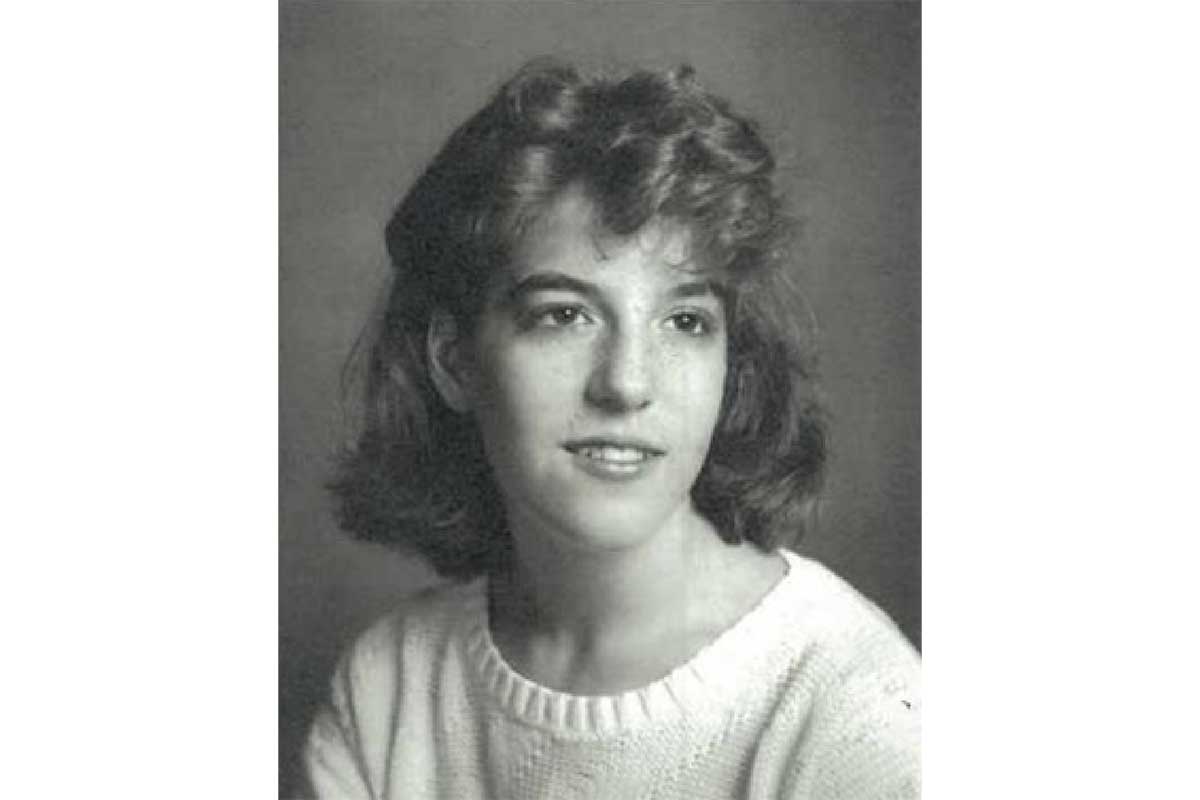
He describes his relationship with Sue Baker, mother of 18-year-old Amy Baker, who was murdered in 1989 when she ran out of gas on Interstate 95 in Springfield. It was Baker who discovered her daughter’s body in the woods near the exit ramp where police had found Amy’s blue Volkswagen Beetle and had it towed, thinking it was abandoned. “I knew my child, and I knew something wasn’t right. I wasn’t waiting for anyone and just started searching,” Baker says.
Long realized that Baker’s entire life was consumed with trying to make sense of what happened to Amy that night. “She needed answers,” he says. Last year, the Fairfax County Police Department was finally able to deliver those answers when Amy’s killer, Elroy Neal Harrison, was identified through DNA evidence. In a separate but collaborative investigation, Harrison was also linked to the 1986 murder of Stafford County resident Jacqueline Lard. Harrison was found guilty of Lard’s murder on June 26 and faces sentencing in October.
“Without Jon Long and Melissa Wallace, this case would have never been solved, and I would have died not knowing who killed Amy,” says Baker. “We went 35 years with nothing, but then Jon tried everything in his power to get the right DNA testing. He was like a pit bull, and I just love him for it.”
Baker also praises Stafford County Sheriff’s Office Detective D.K. Wood for tracking down Lard’s killer, which was critical to solving her daughter’s case. “They are all heroes,” she says. “These detectives are the epitome of what we want in our public servants.”
Baker goes to every court appearance that involves Harrison. “It’s difficult to even look at him, but I have to imagine Amy and Jacqueline were not his only victims. Maybe it’s huge, wishful thinking, but if this person has even a shred of a conscience, he will tell them everything he has done.”
Loudoun Mysteries
Loudoun County Sheriff’s Office (LCSO) Cold Case Detective Jorge Garcia says every killer leaves their identity at the crime scene. “The answer is within the case file, but the challenge is finding it. My job is to find the rocks that have not yet been turned.”
He describes his approach. “I begin with a victimology workup, a victim timeline, a suspect timeline, and a list of potential interviews. With these steps, I can bring new life back to a case and find new leads to follow. You can’t do this job by yourself. You always need outside help or direction.” Collaboration usually includes other detectives as well as federal agencies, the media, medical examiners, state and private laboratories, multiple state and national databases, and university forensics departments.
Garcia thinks of each case as a puzzle. “I separate myself emotionally and look at it from an outside perspective so I can see all the pieces clearly — the missing pieces, the pieces turned over, the pieces in the wrong places. It’s a long process, but when that final piece of the puzzle is found, you have an answer for a loved one. The heartache is still there, but the answer allows them to move on.”
Loudoun County Sheriff Michael Chapman recognizes the importance of cold case investigations. “Each solved case not only honors the victim, but also sends a powerful message that we don’t forget. Every victim deserves justice. Every family deserves answers. And our Cold Case Unit ensures that the passage of time will never be an obstacle to fulfilling that promise,” Chapman says.
LCSO’s cold cases include unidentified and missing persons. One of those is Agnes Banwell, who was 80 when she disappeared in July 1994, just five days after reluctantly moving from New York to live with her son in Purcellville.
Banwell’s granddaughter, Karen Murphy, lives in Mineola, New York, and she stays in contact with Garcia. Murphy, who was 22 when Banwell disappeared, says her grandmother was experiencing early signs of dementia. “She was supposed to have an aide helping her get adjusted, so I don’t know how she just walked out of the house without anyone noticing. My father and I didn’t learn she was missing until the next day when we called his brother, my uncle.”
Murphy and her father drove from New York to Virginia. “I made fliers and hung them at every rest stop on the way, in case my grandmother was trying to get back to New York,” she says. Murphy describes a full police search with bloodhounds and helicopters that yielded no results.
“The experience aged my father like 20 years overnight. He died six years ago without knowing what happened to his mom,” says Murphy. “I’m thankful that Detective Garcia is going the extra mile on this investigation now. He’s looking at every angle and trying to figure it out so we can possibly have some kind of closure. My grandmother would now be 113, so I know she has passed. If she’s a Jane Doe somewhere, I would love to give her back her name.”
Prince William County Cold Cases
Prince William County Police Department (PWCPD) Master Detective Giannina Pinedo says it’s important to remind the public of cold cases, usually on the anniversary of the death. “Those notices may reach individuals who have the piece of information we need to close the case, even if they think it’s insignificant.”
Pinedo is the only detective assigned full time to PWCPD cold cases, but her colleague from the Intelligence Unit, Master Detective Colleen Grantham, assists often. “We keep our cold cases in the public eye as much as we can. Nothing happens in a vacuum, and there are people out there with information who haven’t been willing or able to share yet who we want to reach,” says Grantham.
PWCPD currently has 32 cold cases. “I imagine my brain as an old-fashioned slide projector, with each slide containing information regarding my cases,” says Pinedo. “As a detective, there’s no such thing as a work schedule. As much as I try not to take it home, these cases are always with me, and anything can trigger my mind to think about a specific case.”
One case that stays on Pinedo’s mind is the 1986 Dale City murder of 15-year-old Lisa Renee Triggs. Triggs went missing as she walked home from a grocery store. Her body was found three days later in the woods near Dale City Recreation Center.
The case stays on the mind of Prince William County Police Chief Peter Newsham as well. “That murder has significantly impacted Lisa Triggs’ family for decades,” says Newsham. “On behalf of all cold case survivors, it’s our responsibility to do everything we can to find the person responsible and hold them accountable. Our detectives eat, sleep, and breathe this important work. I’m in absolute amazement of the amount of effort they put into their job.”
A Mother’s Heartache
Debbie Paolino, Triggs’ mother, says her daughter’s death changed her life forever. “It’s been 39 years, but thinking about it brings back overwhelming emotions of pain, anxiety, guilt, what-ifs,” she says. “Tears still well in my eyes. A part of me died the day Lisa died.”
Lisa’s murder greatly strained her family. “As time passed, her brother, father, and I dealt with the grief differently. The house became occupied with three strangers.” After divorcing, Paolino remarried.
“I have learned to smile again,” she says. “I became an emergency medical technician at age 50, something that was never in my plans. During my 15 years of being with the Dale City Fire Department, I was there for several mothers and listened to their grief of the loss of a child. I learned compassion for others that some wouldn’t understand. I promised Lisa at the funeral that I would never quit searching for who raped and murdered her. I’m so thankful to have had Lisa in my life for 15 years, and she would want me to be happy and go on living.”
Fauquier County Cases
Fauquier County’s cold cases are handled by Lieutenant Dawn Arrington in the Criminal Investigations Division. “Every cold case victim is someone’s child,” says Arrington. “Some have siblings, spouses, or other family members waiting for answers.”
For Arrington, cold cases are personal. “My cousin, Laurie Stout, was a homicide victim in 1983 in Austin, Texas, and her case went cold for decades,” says Arrington. Stout’s killer was eventually captured, and in 2017 he pleaded guilty to murder.
“I was born after 1983, but I know the direct impact the case had on my mother’s family,” says Arrington. “My aunt did not live to see the case solved, so I empathize with families who want to see their case solved in their lifetime.”
Modern Technology
Forensic advancements are making it more difficult to get away with murder. “Modern advancements in forensics and technology result in fewer cold cases now than ever before,” says Arrington. “We can do so much more with physical evidence now, and with current technology, digital evidence can lead us to a suspect quicker.”
Fauquier County Sheriff Jeremy Falls is glad. “The work our detectives do on cold cases is the most difficult, and potentially the most rewarding,” says Falls. “Evidence and recollections are sometimes decades old, but we never forget that at least one person holds the answer and needs to be held accountable. And that victims’ families are longing for closure.”
Feature image of FCPD detectives Jon Long and Melissa Wallace by Michael Butcher
This story originally ran in our August issue. For more stories like this, subscribe to Northern Virginia Magazine.