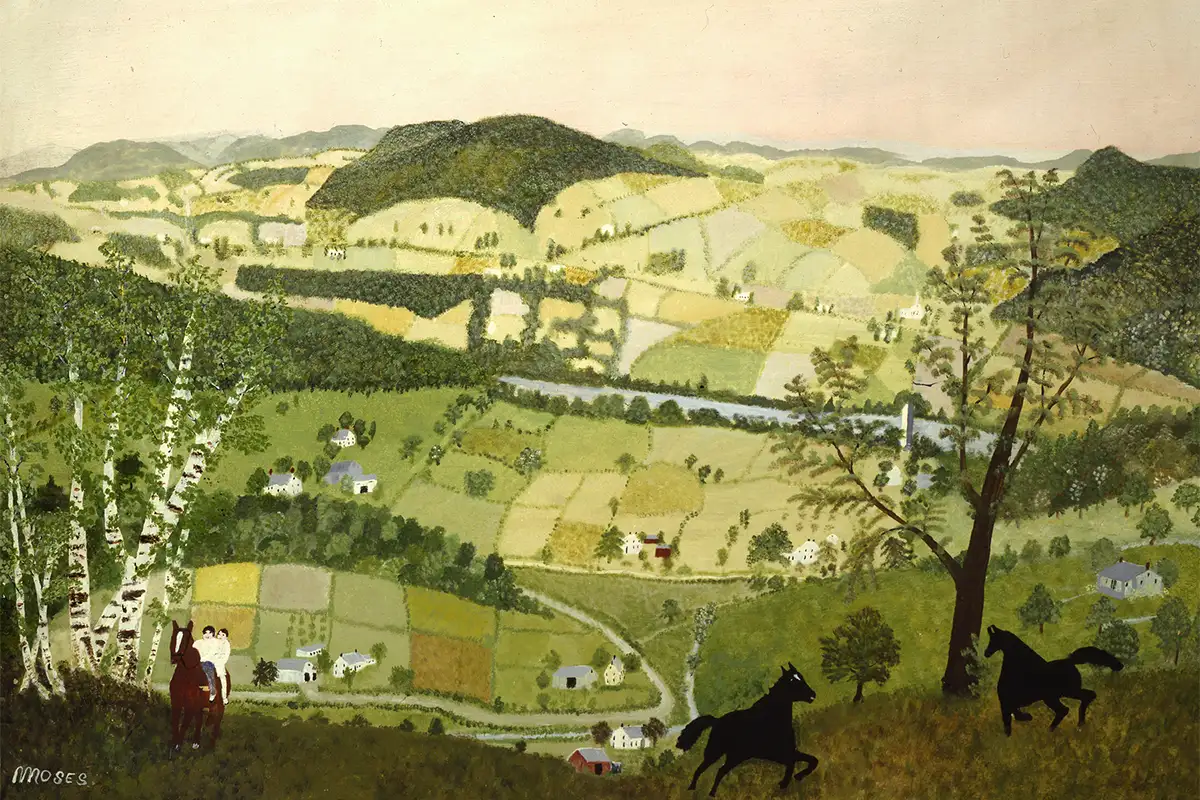
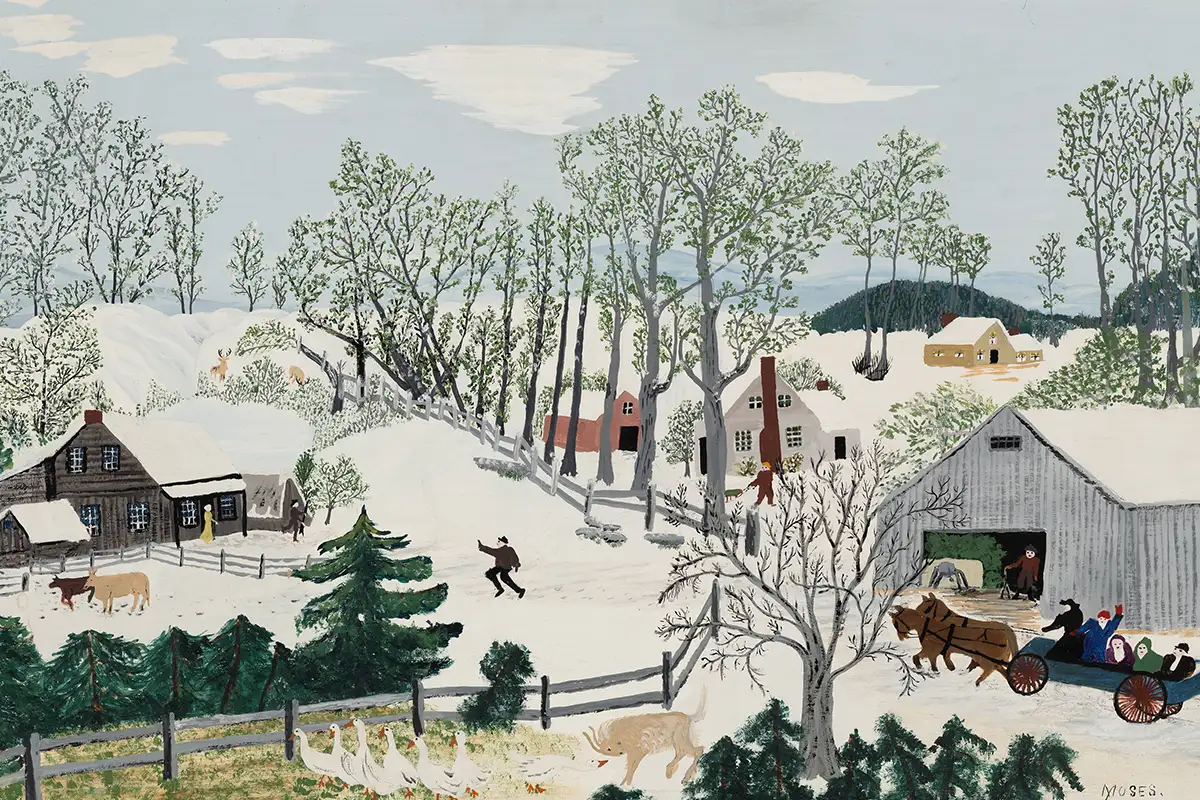
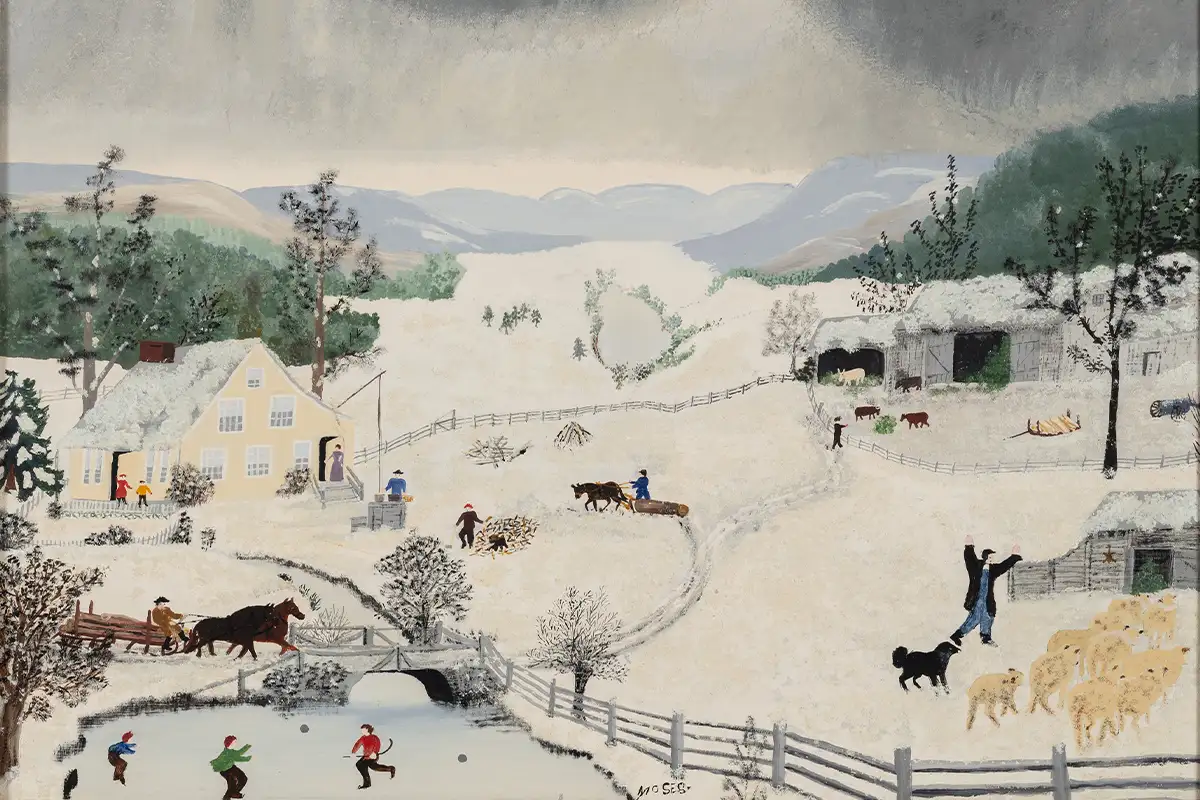
It’s fitting that a new exhibition on the work of American artist Anna Mary Robertson “Grandma” Moses opens on November 25 at the Smithsonian American Art Museum (SAAM) — right before the holiday season. After all, many of Moses’ primitive landscapes focus on holiday traditions and preparations like fall harvests, tables set for feasts, horse-drawn sleighs loaded with cut evergreens, and even Santa and his reindeer flying over a snowy, moonlit valley.
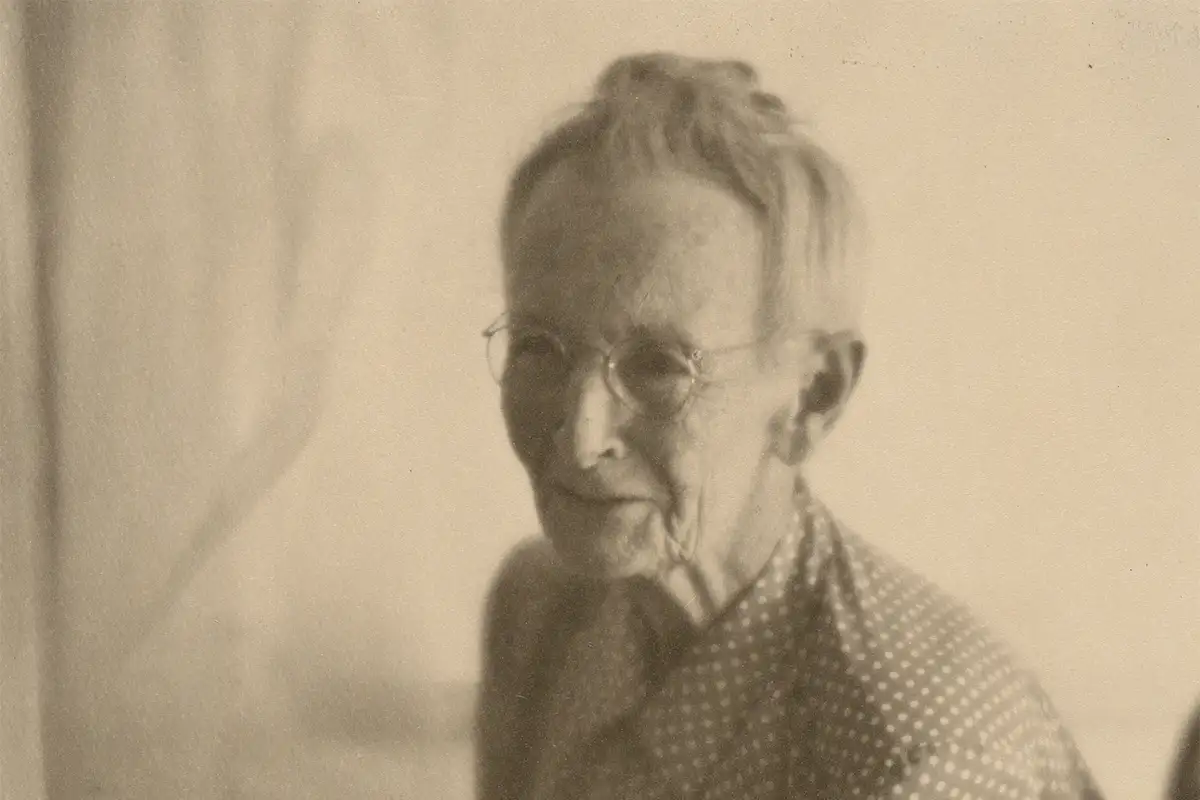
Moses was born in upstate New York in 1860. Her century-long life spanned American history from the Civil War to the Civil Rights Movement. Most of her years were devoted to farm labor and caring for her family. It wasn’t until she was 77 — after her husband died and her children moved away — that Moses had time to teach herself how to paint.
A Thanksgiving festival art display at Gimbels department store in New York City in 1940 launched Moses on her unlikely path to fame at age 80. In October, before the Gimbels showing, gallerist Otto Kallir had introduced Moses to the public with her first solo exhibition, What a Farm Wife Painted. Under Kallir’s representation, Moses’ popularity steadily expanded.
A collaboration with Hallmark in 1947 produced greeting cards that spread the artist’s nostalgic, rosy vision of the American dream around the globe, and soon her images were marketed on draperies, linens, dishware, and other household objects. But as the tiny, bespectacled widow’s fame and success increased, many in the art world refused to accept her as a serious artist.
The Merger of Work, Memories, and Creativity
Grandma Moses: A Good Day’s Work is on display at SAAM through July 25, 2026. The title was based on a quote from Moses’ 1952 memoir, My Life’s History: “I have written my life in small sketches. … I look back on my life like a good day’s work, it was done and I feel satisfied with it.”
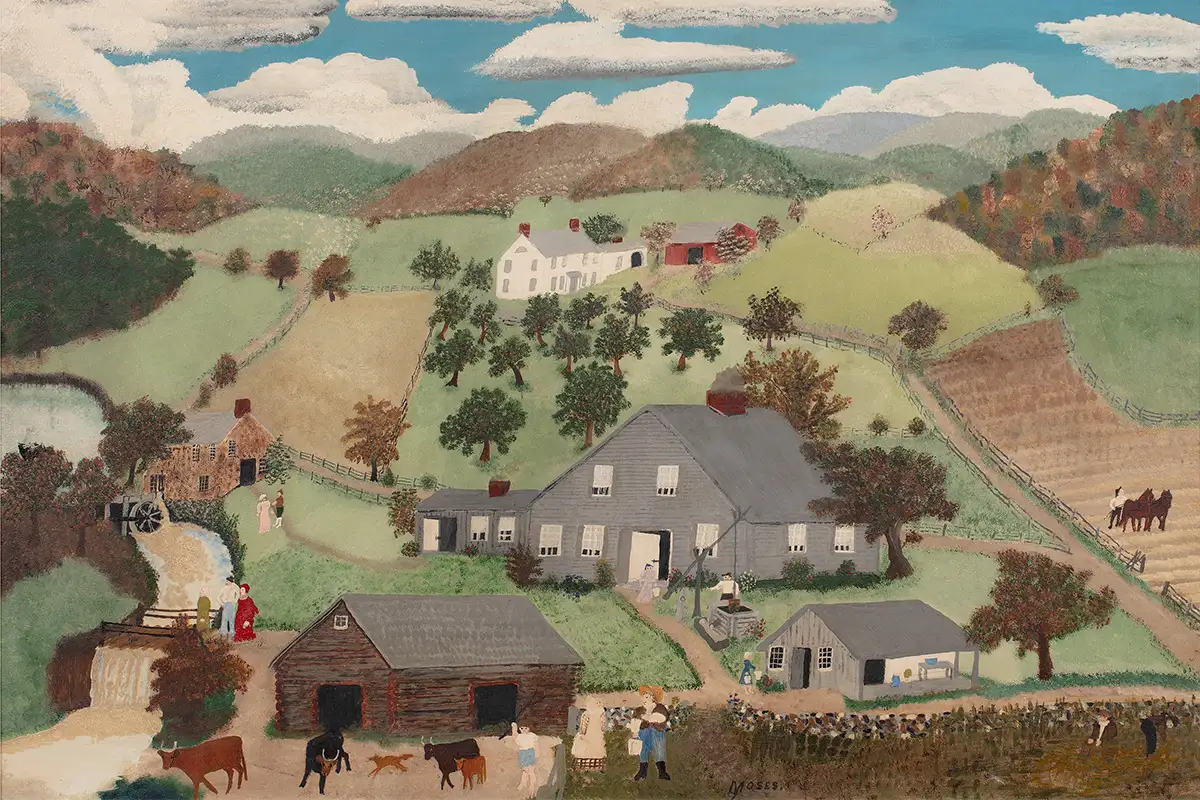
Tosto, Promised gift to the Smithsonian American Art Museum, in memory of Dr. R. David Sudarsky,
© Grandma Moses Properties Co., NY
SAAM head curator Randall Griffey says the title encapsulates how Moses thought about her life and art, noting that work is a prevalent theme throughout the memoir. “It appears in seemingly endless variations — ‘women’s work,’ ‘farm work,’ ‘house work,’ and more,” says Griffey.
Move to Virginia
Anna Mary Robertson left home for good when she was just 12 years old to work as a live-in “hired girl” for wealthy neighboring families. At 27, she married Thomas Salmon Moses, a “hired man” at one of those homes. The newlyweds soon moved to Staunton, where they took over as tenants for a local farm.
“Less than a week after we were married, we were housekeeping amongst strange people in a strange land,” Moses said in a 1956 radio interview.
American Art Museum, Promised gift from the Kallir Family, © Grandma Moses Properties Co., NY
The couple remained in the Shenandoah region for 18 years, working multiple farms and having 10 children (only five survived infancy) before returning north and buying a farm in Eagle Bridge, New York. When Thomas died in 1927, Moses continued to manage the farm, where she later created all of her paintings. She was 101 when she died on December 13, 1961.
Virginia Years and Influences
Leslie Umberger, SAAM senior curator of folk and self-taught art, says she was excited to delve into Moses’ Virginia years for this project. “Moses is almost always positioned as a dyed-in-the-wool New Englander, but her Southern period was very important, and, to date, it has received little attention,” says Umberger.
Umberger cites Moses’ 1947 painting Apple Butter Making as a joyful late-summer Shenandoah Valley activity that lingered in Moses’ memory long after her family returned north. The paintings Shenandoah Valley South Branch and Shenandoah Valley (1861 News of the Battle) show the point where the Shenandoah River intersects the Blue Ridge Mountains, at the foot of Bolivar Heights, a strategic site overlooking Harpers Ferry, West Virginia, during the Civil War. Other paintings, like Down in Shenandoah, simply recall the great beauty of the valley Moses had very much loved.
Smithsonian American Art Museum: Eighth and G streets NW, Washington, DC
Feature image Grandma Moses, Black Horses, 1942, oil on high-density fiberboard, Smithsonian American Art Museum, Museum purchase through the Luisita L. and Franz H. Denghausen Endowment, 2024.37.4, © Grandma Moses Properties Co., NY
This story originally ran in our November issue. For more stories like this, subscribe to Northern Virginia Magazine.