The distance from Chicago to Manassas is around 700 miles, but for LaTanya McDade, it seemed a whole lot longer.
“My siblings and I grew up on the south side of Chicago,” says the Prince William County Public Schools superintendent. “We grew up poor, but we didn’t know. My parents immigrated to the United States from Belize City, Belize, looking for a better way of life.”
McDade’s father worked collecting coins from vending machines, and her mother cleaned homes for affluent families. It wasn’t until McDade tested into Chicago’s elite Whitney M. Young Magnet High School that she discovered other kids grew up differently.
“I got to Whitney Young and realized that the world was made up of two buckets of people, right? The haves — their houses, their cars, their whatever; 16-year-olds driving to school in BMWs — and I’m barely scraping to get a bus pass.”
That’s when imposter syndrome kicked in, and the scholarly student began to question her ability to succeed. McDade started cutting biology class, but luckily for her, her high school principal, Powhatan Collins, stepped in.
“He would hang out by my locker, and he would just spark up a conversation, and we would walk,” McDade says. “By the time we finished walking through the hallway, he’d say, ‘Aren’t you supposed to be in biology right now?’ I started going to class. He did that, just walking with me to biology class. And when he stopped, I didn’t stop going, because I knew he cared.”
McDade’s family couldn’t afford to send her to college, and the onus to fill out the financial aid forms was on her when she was a high school senior. As a result, she received a letter informing her she would receive no financial aid.
“That was the first time I saw my mother cry,” McDade says.
At school the next day, McDade told Collins about her situation. “He said, ‘No, something’s wrong. Absolutely not. You’re going to college,’” she recalls.
Collins corrected her financial aid application errors and connected her with Southern Illinois University, where she received a full financial aid package. McDade later transferred to Chicago State University, where she earned a bachelor’s degree in elementary education. She eventually earned a master’s degree in leadership and administration from Loyola University Chicago and a doctorate in educational leadership and supervision from Lewis University.
“It was because of Mr. Collins’ access to opportunity, to knowledge, to resources, that ultimately I lived out not only my dream to go to college, but my parents’ dream for me to go to college,” she says. “Educators like Mr. Collins remind me of the power that we have to really change the trajectory of somebody’s life.”
A Role Model to Students
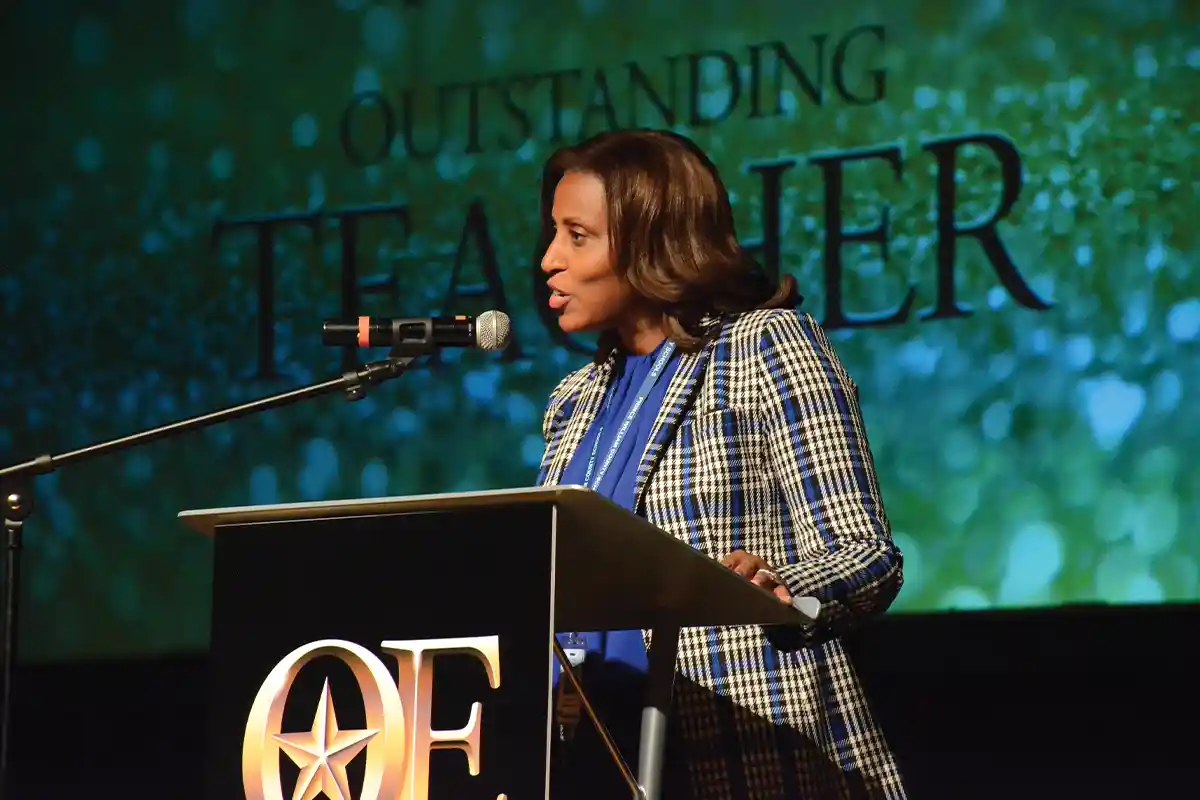
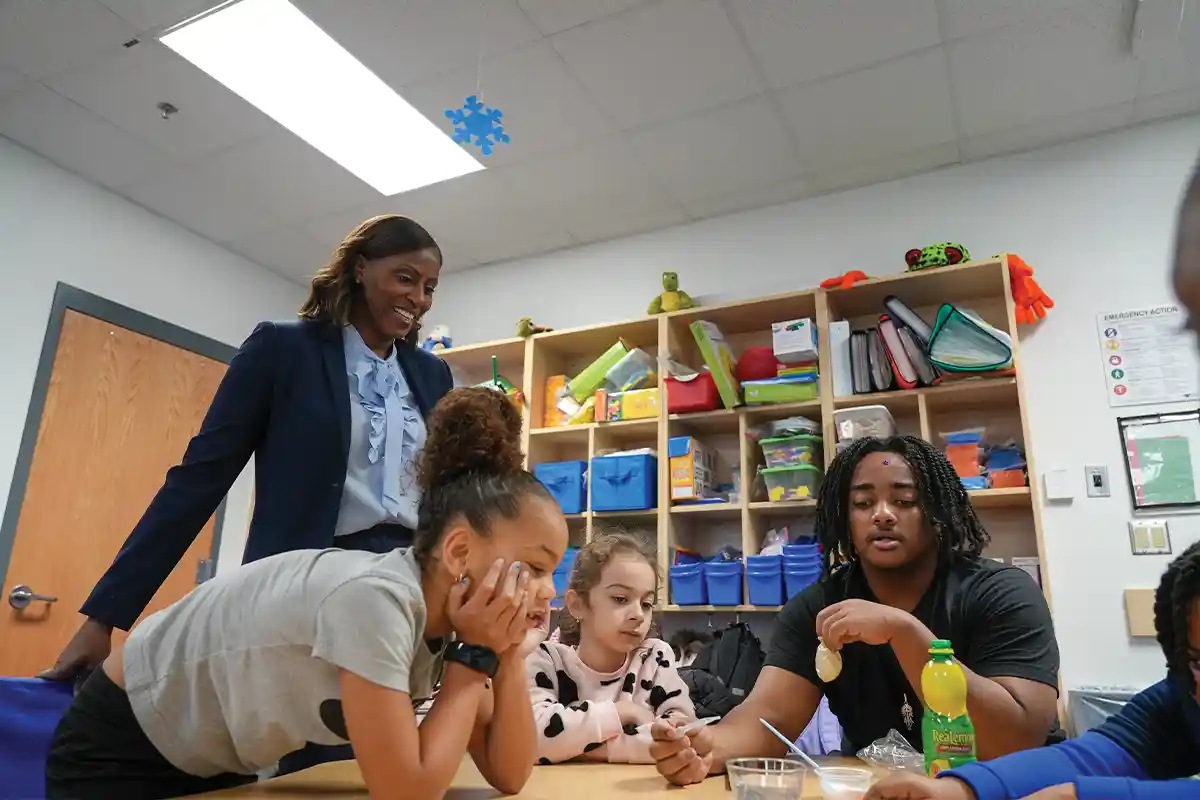
Little did she know, she would one day become the first woman and the first Black person to serve as superintendent of schools for the second largest school district in Virginia. Black women make up fewer than 1.5 percent of the nation’s superintendents, according to Education Week, and McDade’s presence has served as an inspiration to students and staff in the community. PWCS Chief Information Officer Matt Guilfoyle has seen it firsthand.
“The hope that I see in kids’ faces when they see her — especially female students of color — but all students are like, ‘Yeah, this is something I can really aspire to be,’” Guilfoyle says. “Students just flock to her. I’ve seen it from kids who are as young as first grade all the way through high school.”
Rania Lateef, a senior at Colgan High School in Manassas, says she has been motivated by McDade’s example. “What inspires me the most about her is that she’s willing to listen to everyone’s story and she’s willing to give our dreams and our hopes a chance,” says Lateef, 17.
Setting the Pace
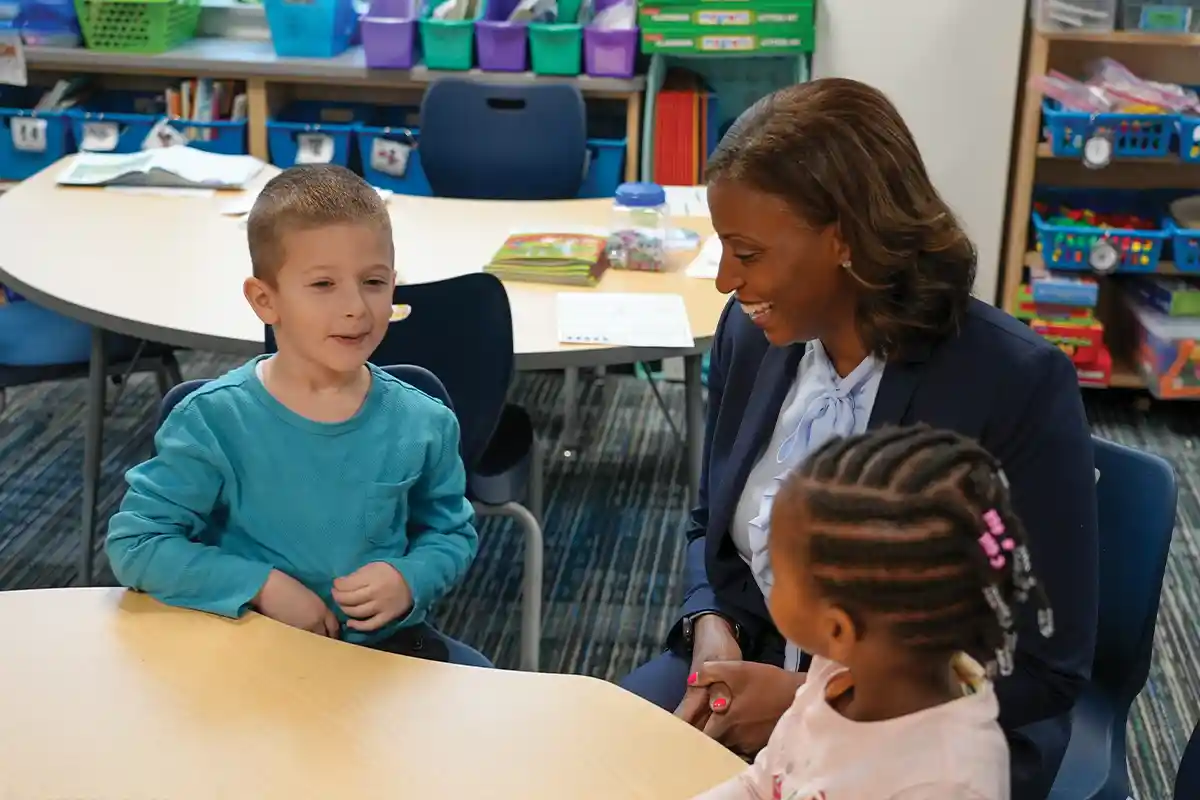
McDade has experienced both sides of the coin: She was once an underprivileged student looking for a robust education, and she’s now a respected leader in Virginia’s most diverse county, which is also the 10th most diverse county in the nation.
She started her career in the Chicago Public Schools system — then the third largest school district in the nation — as an English language arts teacher for middle schoolers. She worked for 23 years in Chicago Public Schools and moved her way up the ranks to the role of chief education officer, where she supported more than 352,000 students across 638 schools and managed a $3.4 billion budget.
“I just learned so much along the way, implemented some tried and true practices, and saw marked success throughout my tenure in Chicago,” McDade says. “I still believe education is the great equalizer, and we had what I call the great American story in public education. Right before I left, we were able to show so much progress and growth in Chicago Public Schools to being a district that was being studied nationally.”
Architect of Transformation
Under McDade’s leadership, Chicago schools increased academic achievement, graduation rates, and college enrollment, and reached record low dropout, suspension, and expulsion rates.
In her personal life, McDade married, had two (now grown) sons, and became an avid marathon runner. She built a living and a life in the Windy City, and in 2021, she felt it might be time for a change.
Her next stop: Prince William County, with about 88,000 students in 100 district schools. Since joining the team in July 2021, she’s set ambitious goals, including reaching a 95 percent graduation rate by 2025; PWCS is currently at 94.3 percent.
“That’s an all-time high for us. The highest graduation rate the school system has ever experienced,” McDade says.
PWCS’ dropout rate for English learners was in the double digits when McDade came to town; now it’s down 9.6 percent.
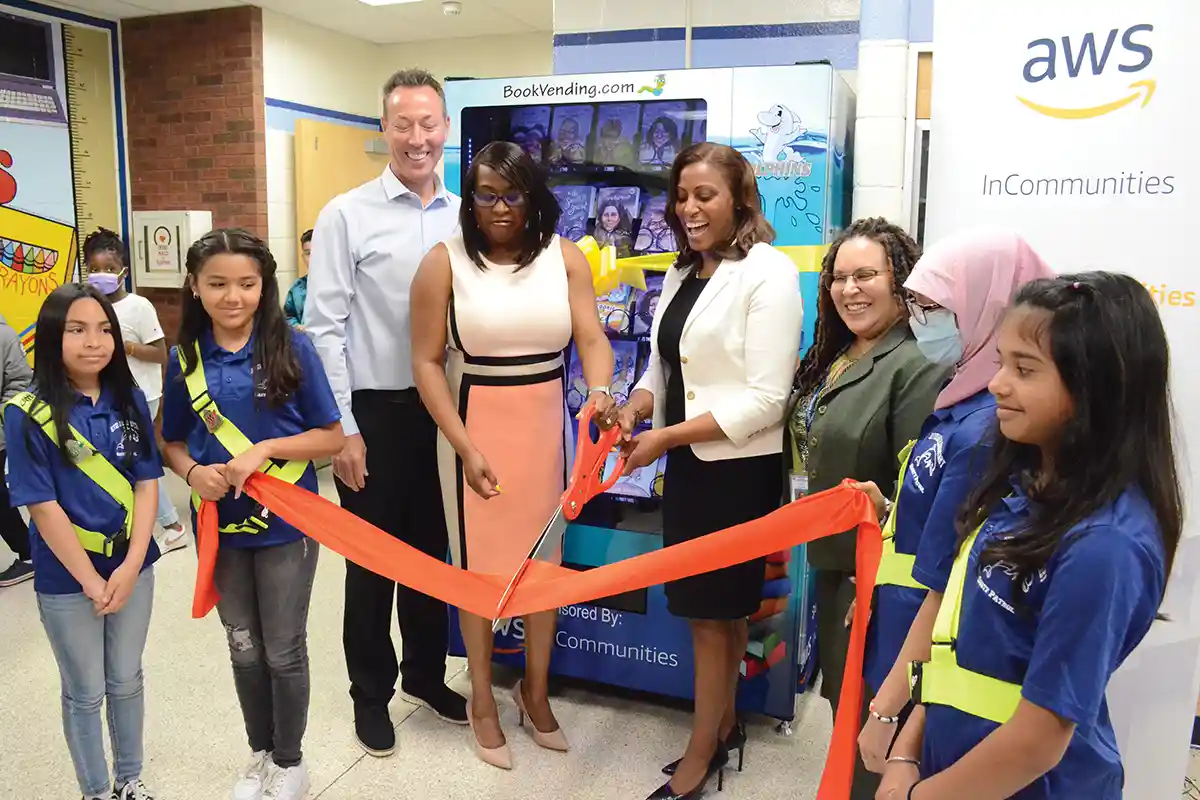
The superintendent also led an effort to ensure that at least 60 percent of students earned an early college or career credential, which put a heavy focus on career and technical education. As a result, the district developed 326 formal business partnerships, and 763 high school seniors have received apprenticeships or internships upon graduation.
“She states these goals, but she’s putting things in place to truly make steps toward reaching those goals. It isn’t just lip service,” says Vanessa Owens, a PWCS teacher and a mother of six.
McDade notes that over the past three years, graduating seniors have earned $123 million in scholarships.
“That is like 30 to 40 percent growth over where we were the first year that I came in,” she says.
Parents notice McDade’s keen ability to listen to the needs of students, staff, and families as one reason she gets the job done.
“Parents have a voice. They have a powerful voice,” says Owens. “It is heard. It is valued.”
Structuring Success
McDade’s contract has been renewed until 2028, so she’s got a long runway to accomplish her mission. In the meantime, the Chicagoan’s own story continues to give students permission to dream.
“With her, you see that anything can happen; it doesn’t matter where you come from,” says Chevelli Smith, principal of Freedom High School in Woodbridge. “You work hard enough, you can actually be what you want to be. I think she helps kids not only to dream, but she helps to put things in place so that their dreams can become a reality.”
Feature image of LaTanya McDade courtesy Prince William County Public Schools
This story originally ran in our February Issue. For more stories like this, subscribe to Northern Virginia Magazine.