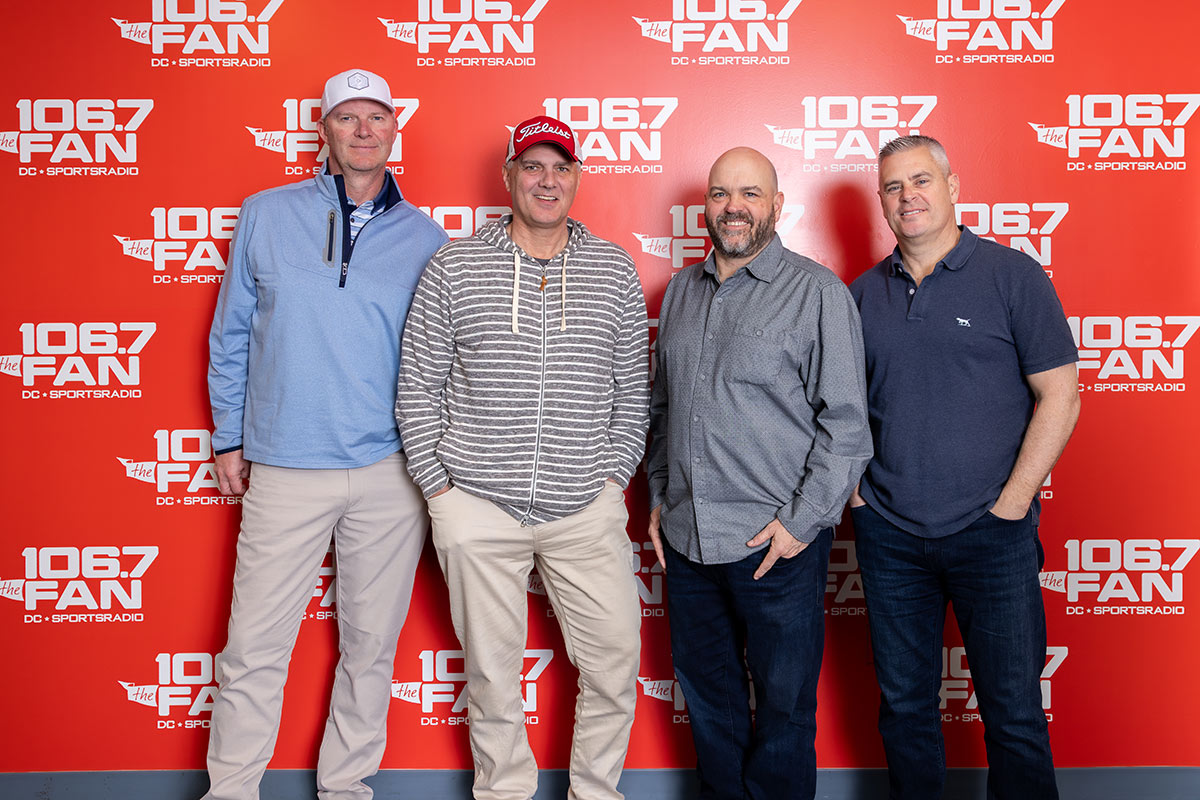
Next year marks the 20th anniversary for WJFK-FM’s morning quartet known as The Sports Junkies, and 31 years since the group of four friends started working together in radio. They took over the valuable timeslot vacated by The Howard Stern Show when the famously unfiltered celebrity abandoned terrestrial broadcasting for satellite radio in 2006.
The stakes were high. Replacing an icon is notoriously fraught, but the Junkies not only lived to tell the tale, they developed a nearly indestructible brand that may prove harder to replace than Howard Stern. If it ever comes to that.
Along the way, as regular listeners know, the four Junkies — John-Paul “J.P.” Flaim, John “Cakes” Auville, Eric “E.B.” Bickel, and Jason “Bish/Lurch” Bishop — have matured, which is reflected in the show they do each weekday from 5 to 10 a.m. (the first hour is a replay).
‘Let’s See What We Can Make Happen’
What began in their adrenalized early-to-mid-20s as a chaotic, anything-goes, boundary testing “morning zoo” — all the rage on the airwaves back then — is now a reliably energetic, smooth flowing sports talk-and-interview show highlighted with anecdotal tangents from their lives.
Not that they’ve lost some of their edge, in fact, they may be hitting their stride in their mid-50s.
“We’re all grown up now, sort of,” says Bickel. “And the audience has matured, too.”
While the Junkies have been a fixture on WJFK’s morning drive time for two decades, the foursome has been on the radio together since 1999 at various stations and timeslots. Rewind further, and they’ve been doing The Sports Junkies format since 1995, when they began an ambitious half-hour program on Bowie, Maryland’s public access cable TV station.
“When we started doing that cable access show, it was kind of a goof. But very early on it was kind of a lightbulb moment for us. Like, let’s see what we can make happen,” says Bickel. “We pushed it and tried to make the best shows possible. There was no social media. The object was to get in the newspaper. Getting in the newspaper was huge!”
“A lot of that was us reaching out. We pride ourselves on making our own luck,” says Flaim. “We did the TV show for a year and said, ‘This is not horrible. We should send it to TV critics.’”
‘Quality, Success, and Longevity’
They did. And in 1996, prominent TV critic and sportswriter Dick Heller gave them a rave review in The Washington Times. That review, Flaim says, “changed the trajectory of our lives.”
“There is no doubt The Sports Junkies have an outstanding history in terms of quality, success, and longevity,” confirms Michael Harrison, founding editor and publisher of TALKERS, considered the authority on all things talk radio. “It is one of the true biggies in the genres of sports talk, guy talk, morning zoo talk, and pop culture talk.”
Harrison cites a small number of broadcasters who have been at it longer than the Junkies. But because the Junkies have a distinctive format, it creates, he says, “an apples and oranges comparison.”
As for the show being less of a morning zoo format now, Harrison says it’s an industry-wide development. “Leading-edge radio does not operate in a vacuum,” he says. “When times change, radio programming changes. … In 2025, the [zoo] envelope has been pushed as far as it could go.”
Early in their career, the Junkies program was syndicated on 50 stations around the country, a nice windfall, but cumbersome to maintain. These days they are heard on WJFK-FM 106.7 “The Fan,” WTEM 980-AM “The Team,” 105-FM and 910-AM “The Fan” Sports Radio in Richmond, and on demand on the Audacy app.
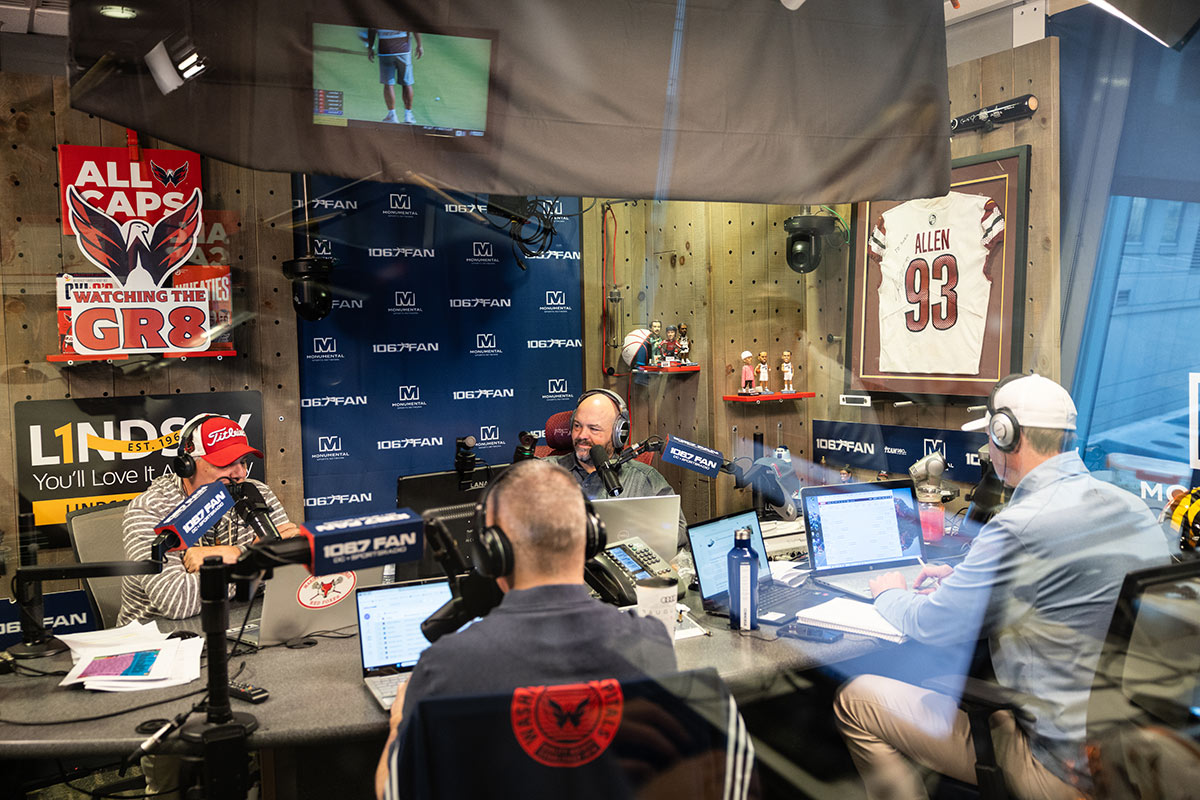
Philadelphia-based Audacy is the second-largest radio broadcaster in the country, with more than 220 stations in 47 media markets. The Junkies broadcast from custom studios in an office building in DC’s Navy Yard neighborhood.
“This is not a radio company we work for anymore,” says Auville. “It’s a digital audio company. We can’t just be available on the radio. We have to be available via streaming. We have to be on all the podcast platforms.” To that end, every segment of the live show is posted individually for streaming consumption at any time.
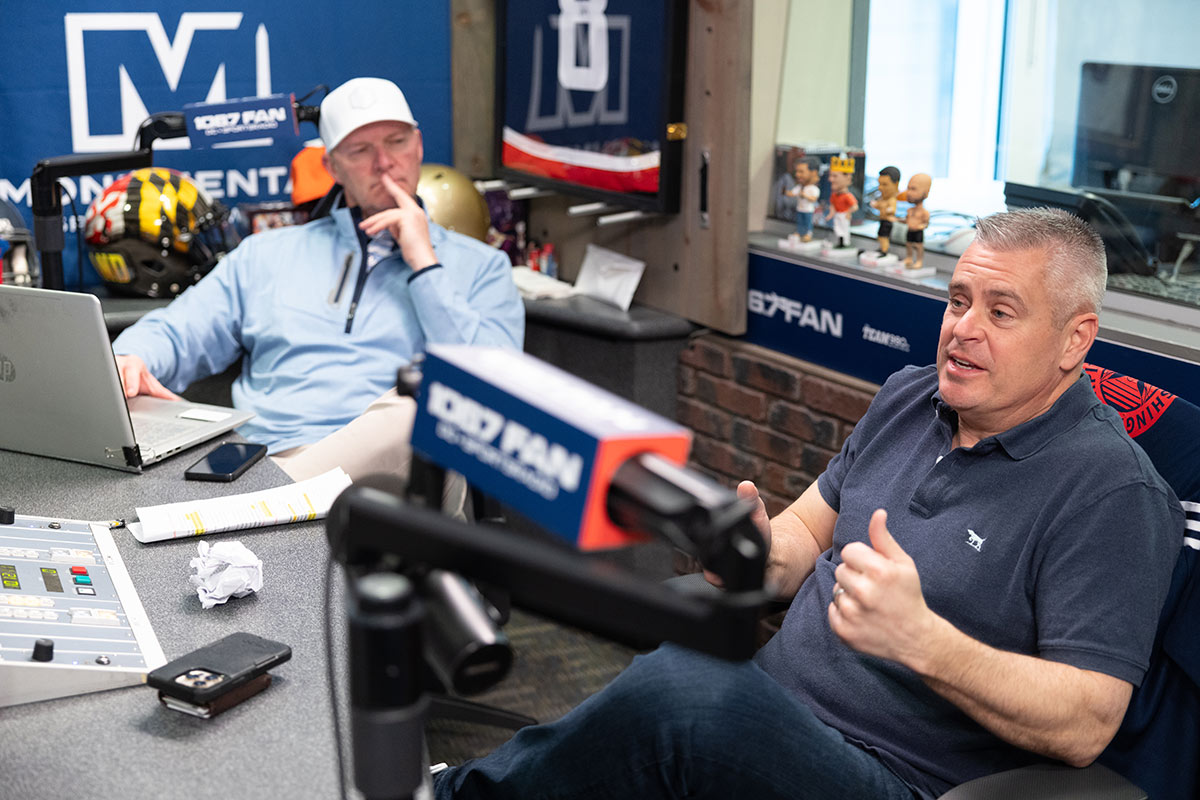
They’re also on television. Their morning show is aired live on Monumental Sports Network, which has unobtrusive cameras stationed around the studio. The studio is kitted with simulated wood and brick, framed game jerseys, and innumerable sports bobbleheads that keep an eye on the proceedings. The Junkies, wearing headphones, sit with laptops and printouts at microphones around a table.
On the other side of a glass window are the two Matts, longtime producers Matt “Drab T-Shirt” Cahill and Matt “Valdez” Myers, vital components of the Junkies’ on-air chemistry.
‘Losing Teams Are Not Good for Us’
Over the years, the Junkies have seen the region’s sports teams at the highest of the highs and lowest of the lows. The NHL’s Washington Capitals, for instance, won the Stanley Cup in 2018 and included the Junkies in the victory parade. A year later, MLB’s Washington Nationals, who were still playing at RFK Stadium when the Junks first started broadcasting, won the World Series in dramatic fashion.
But for their entire morning career, the primary driver in any market for sports radio — the local National Football League team — has struggled on the field. And management was openly hostile to the fanbase at times.
Until last season, that is. And few are happier about the Washington Commanders’ performance than the Junkies.
“It’s much better to have ‘Victory Mondays’ than ‘Misery Mondays,’” Auville says of the day-after program. “A lot of people think we thrive on the dysfunction and the losing, but a winning team does a million times better than covering a losing team. A team that loses and loses and loses, well, fans lose interest, apathy sets in, people stop listening. Losing teams are not good for us.”
No matter what the teams do the day before, the Junkies bring an undeniable communal energy to the air every morning, even on Misery Mondays. They clearly like each other despite the occasional, somewhat heated disputes over vacation times, poker games, and what snacks get brought into the studio. But no one ever leaves with a bruise.
‘Everybody’s Personality Is Different’
And it’s only natural that the idea of retirement after 30 years together crosses their minds.
“Sure, we all think about it,” Flaim says, “but everybody’s personality is different,” meaning they are not all necessarily on the same timeline. But can one go and the others stay?
“Yeah, why not?” says Ashburn resident Bishop, the lone Junk who commutes from Northern Virginia. “You want to enjoy life and not get up at 4 in the morning every day.”
While there’s another year to go on their current deal with Audacy, Bishop says nothing is set in stone for the future.
“We don’t really know what the company’s direction is going to be after our current contract,” he says. “I think we all assume they’re going to want to keep us. I don’t think sports is going to die. But we have no idea how much they’re going to offer, in years. We have no idea.”
Whether it’s one more year or 10, the Junkies have already done what few in broadcasting ever manage: They’ve turned a friendship into a franchise. And a morning habit into a legacy.
Feature photo by Michael Butcher
This story originally ran in our June Issue. For more stories like this, subscribe to Northern Virginia Magazine.