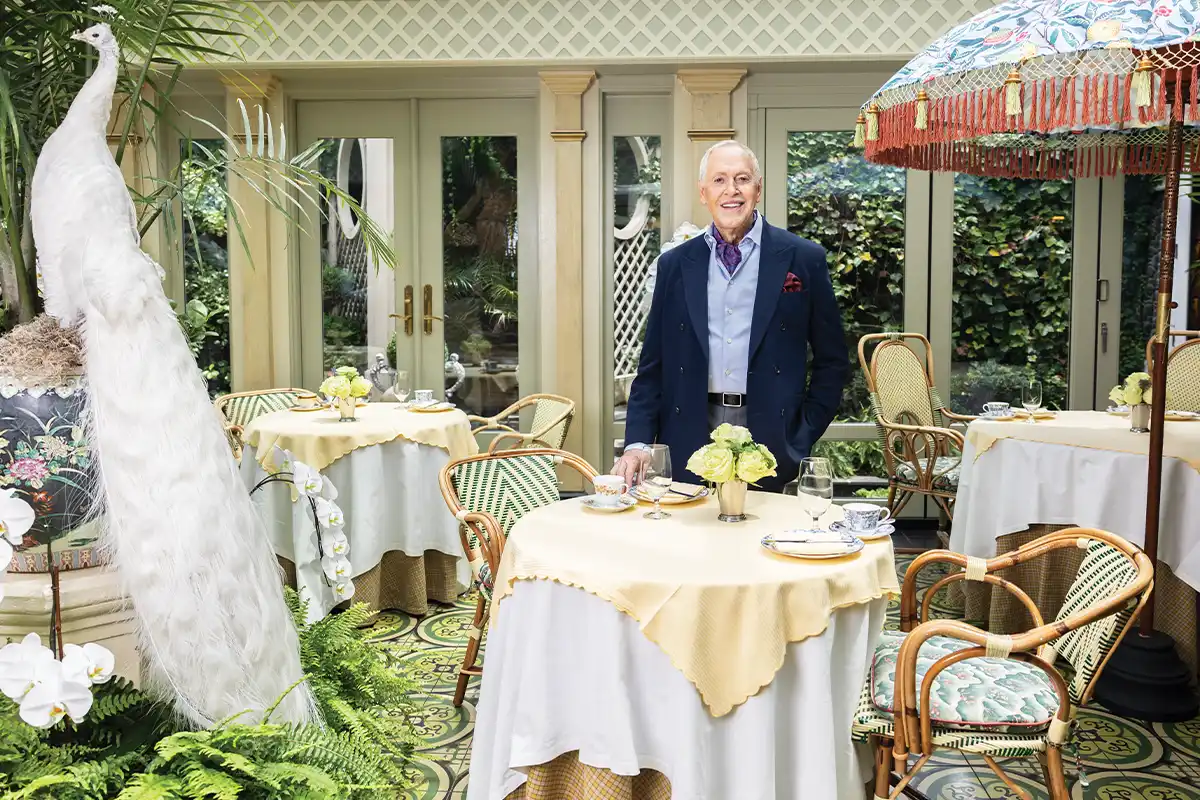
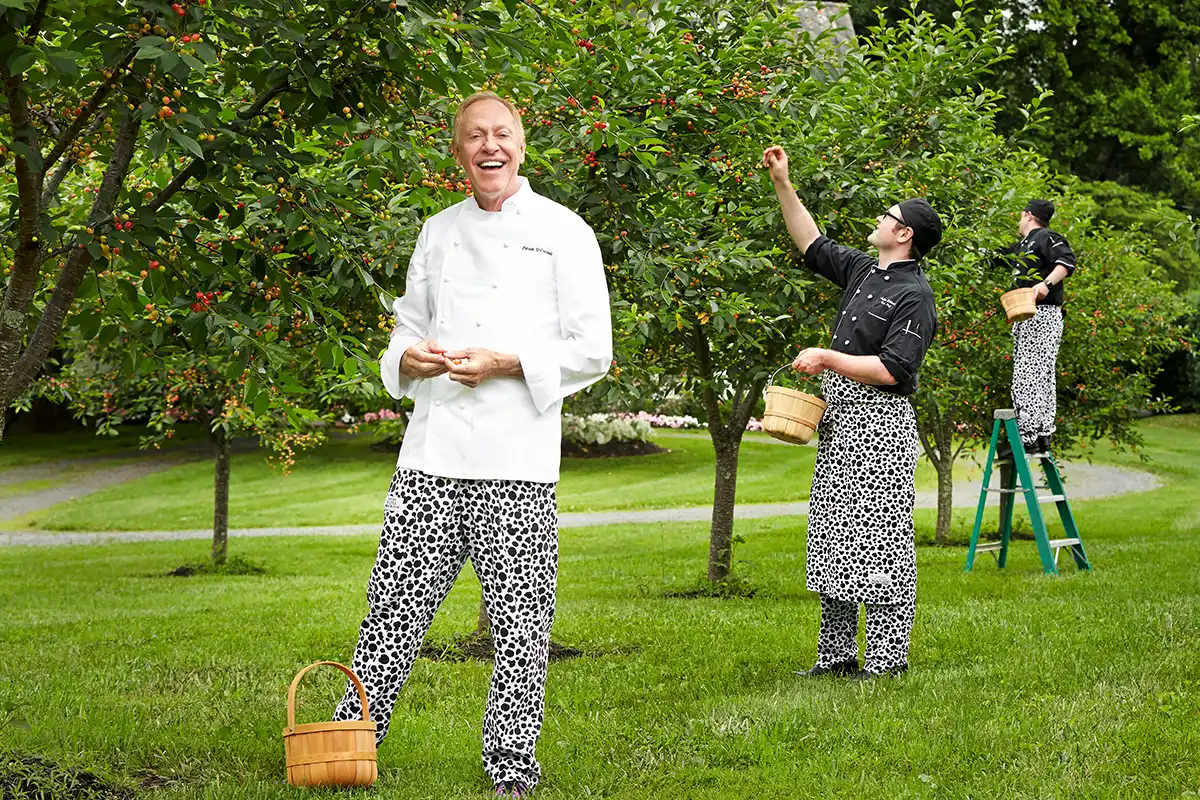
Creating an “oasis” and a meal that makes guests “swoon” has been Patrick O’Connell’s life’s work. And even as he turns 80, the celebrated chef has no plans to step away from the helm of the only three-star Michelin restaurant in the DMV.
“Our place is very different in that it just is an extension of home. It’s always felt like home,” O’Connell says of The Inn at Little Washington. “It’s a house that is bigger and has a large staff and welcomes quite a bit of company every night, but it never has felt any different than welcoming guests into my home. So, when people ask, sometimes, ‘When are you going to retire?’ Well, when are you going to stop welcoming guests into your home?”
O’Connell does treat patrons as if they’re his personal guests. He stops to talk with them, asking whether they have been to The Inn before and listening intently to their stories of what has brought them there — or brought them back.
The Duality of Success
It’s not easy to maintain the perfection required of a three-star Michelin restaurant, a distinction given to restaurants with “exceptional cuisine worthy of a special journey.” The Inn is one of only 16 restaurants with this rating in the U.S., and all of the others are in New York, Chicago, and California.
“I think there’s always a duality to any kind of success. There’s comedy and tragedy. If some young person said, ‘I want to be just like you,’ or ‘I’d like to do this exact same thing,’ I’d say, probably, ‘Not so fast,’” he admits with a hearty laugh. “Maybe you wouldn’t. It’s not all just roses and deliciousness.
“There is the toll that it takes, as any art form does. There is pain. You’re essentially living outside normalcy. And that is a wonderful place to live, but it is odd, and you’re not part of society, really,” he says.
“There are many forces that are at work in achieving something. The good thing is that now there is a whole brigade of people,” O’Connell says of The Inn’s staff of 280 — quite a shift from when it first opened in 1978 and he was cooking and serving meals with his partner.
“It’s very physical work. It’s like a sport, and you can’t in later years vigorously play tennis, for example, the way you did. But the beautiful thing here is that these people can do a lot of the physical work, and you can serve as an editor and a corrector. You can be the flaw finder and the most discriminating guest — that’s very often the role I play.”
And O’Connell doesn’t hold back in that role. “I will spit it in the trash if it warrants that, to get the point across. Somebody has to do that. … People need to be self-critical. They need to be harsh if they want to achieve anything. It should never be good enough.”
That’s the kind of grit it has taken to create this world-renowned restaurant and inn in a building that was once a rundown gas station in the Virginia countryside, 70 miles from Washington, DC.
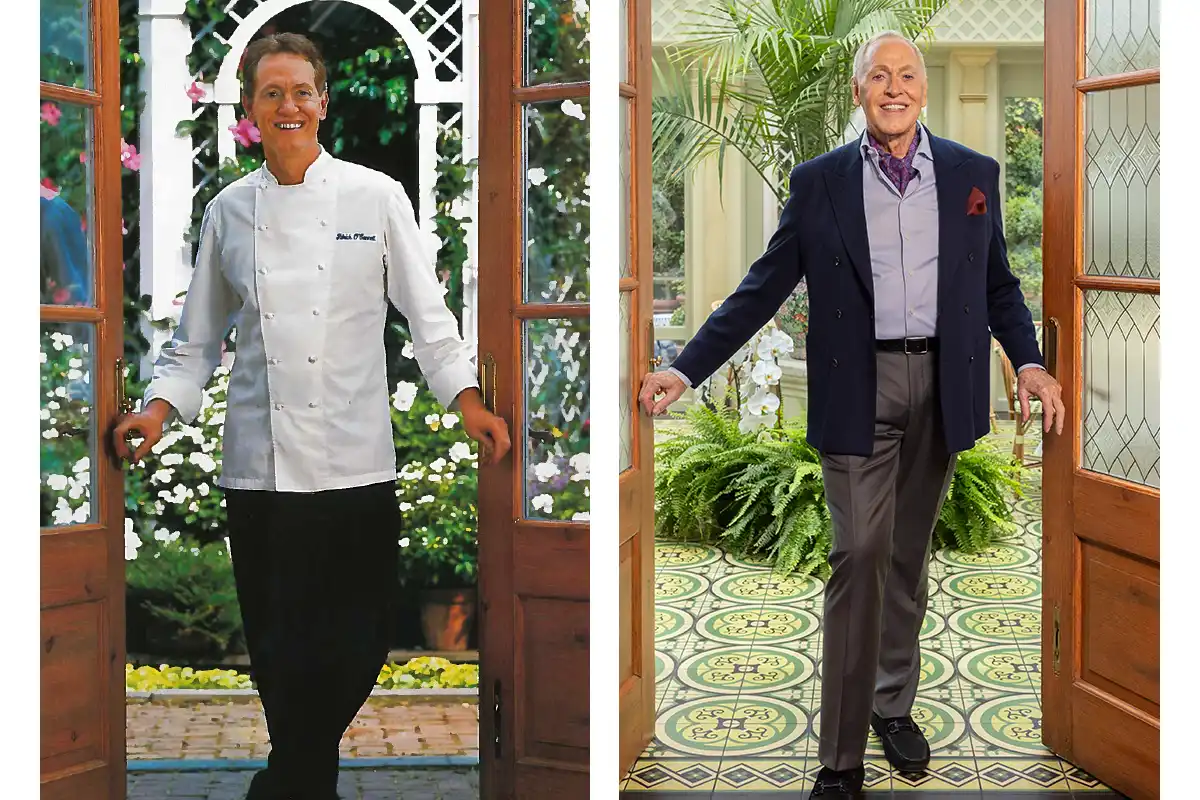
(Courtesy The Inn at Little Washington, left; photo by Michael Butcher, right)
A Chef Is Born
O’Connell got his start in the restaurant business at “a dive” in Clinton, Maryland, when he was just 15 years old.
“It was disreputable, but the people were divine,” he says. At that time, restaurant jobs were for “eccentrics and misfits and people who didn’t fit in. And people who were gritty and a little bit like circus people or theater people. They were their own culture and breed,” O’Connell says. (In those days, he wanted to be an actor.)
“There’s a camaraderie and there’s a nonjudgmental quality about people who work in kitchens,” he says. “Everyone is accepted. It doesn’t matter if you’re a little bit crazy — it’s expected, actually. As long as you throw yourself into the work, there’s a place for you.”
He went to college, but when he couldn’t decide what he wanted to do for a career, he took a year off to travel to Europe.
In France, he “saw the reverence that the French people have toward all things related to food and chefs. I realized it was a noble profession, it was an art form, it was something worth pursuing,” he says.
“At that time, American restaurants were still locked in the ’50s. They hadn’t evolved. There were very few restaurants on par with those in Europe, if any. So I also couldn’t get over how delicious everything I ate in France was. It was a revelation for me. I didn’t know food could taste that good.”
When he returned to the U.S., he built on his new love of French culture and began teaching himself to cook using Julia Child’s Mastering the Art of French Cooking, which was published in 1961.
He bought a piece of land near Washington, Virginia, with a mountain shack that had a school bus attached to the rear and an outhouse. “As soon as I got here, I felt this is where I belong,” he says.
He started catering parties for a wealthy couple who had a home in the area. As word of mouth spread, his customers started telling him he should open a restaurant — and he heard about a space in “little” Washington.
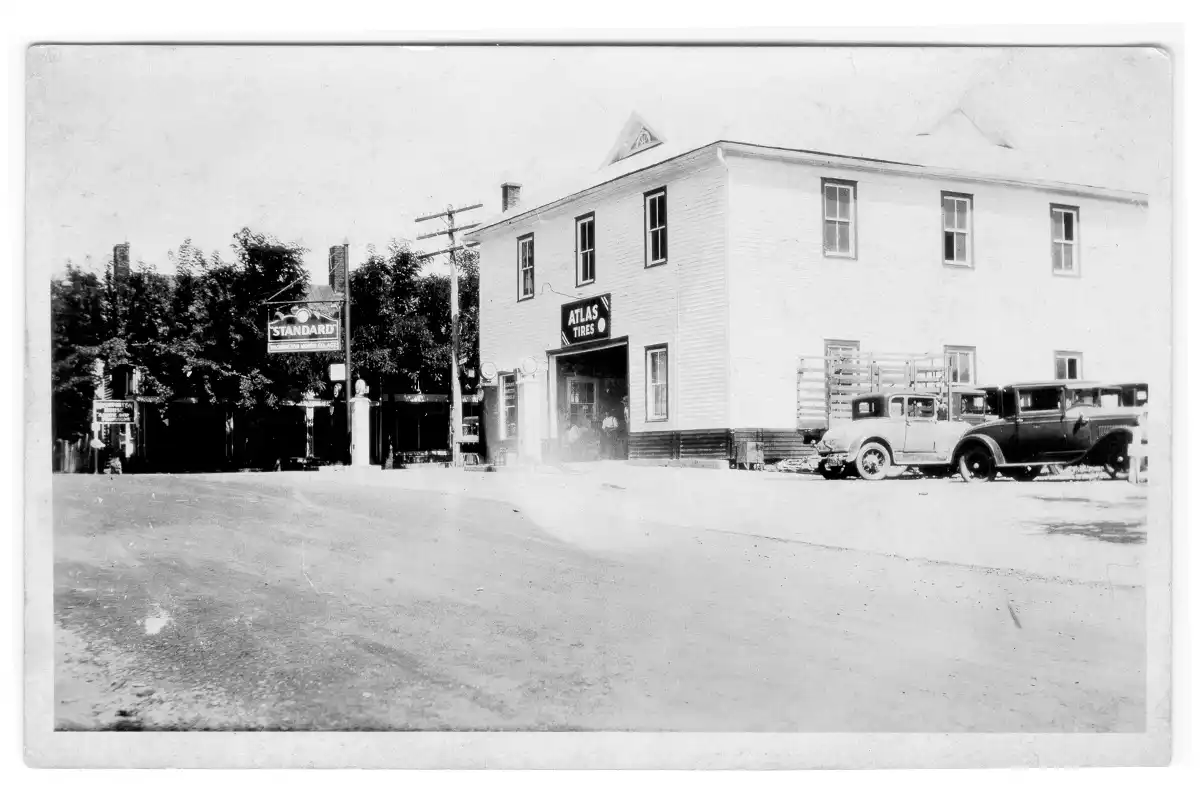
(Courtesy The Inn at Little Washington)
“This building was kind of derelict and wobbling,” O’Connell says as we sit at his favorite table, a corner seat just off The Inn’s main dining room. “Two women owned it, and they rented us half the building for $200 a month to begin. Where we are sitting right now was the junkyard that went with the gas station. The outhouse was right over there,” he gestures.
That’s difficult to imagine in this sumptuous space that was purposefully created to look as if it has been here forever.
“It had to look and feel like the grand country house,” O’Connell says, adding that it was always his plan to include a place for people to stay. “A British country house and a French country house are very different than a typical American country house. They’re wonderfully luxurious, very often, and full of follies and surprises and quirks.”
The Early Days
In the restaurant’s second week, a food critic who had a weekend home in the area dined at The Inn. In a glowing review for The Evening Star (then a prominent DC-based newspaper), he wrote that it was the best restaurant within a 150-mile radius of Washington, DC. With dinner still at $5 per person, the place filled up, O’Connell says. “I really didn’t have time to look up for about 10 years.”
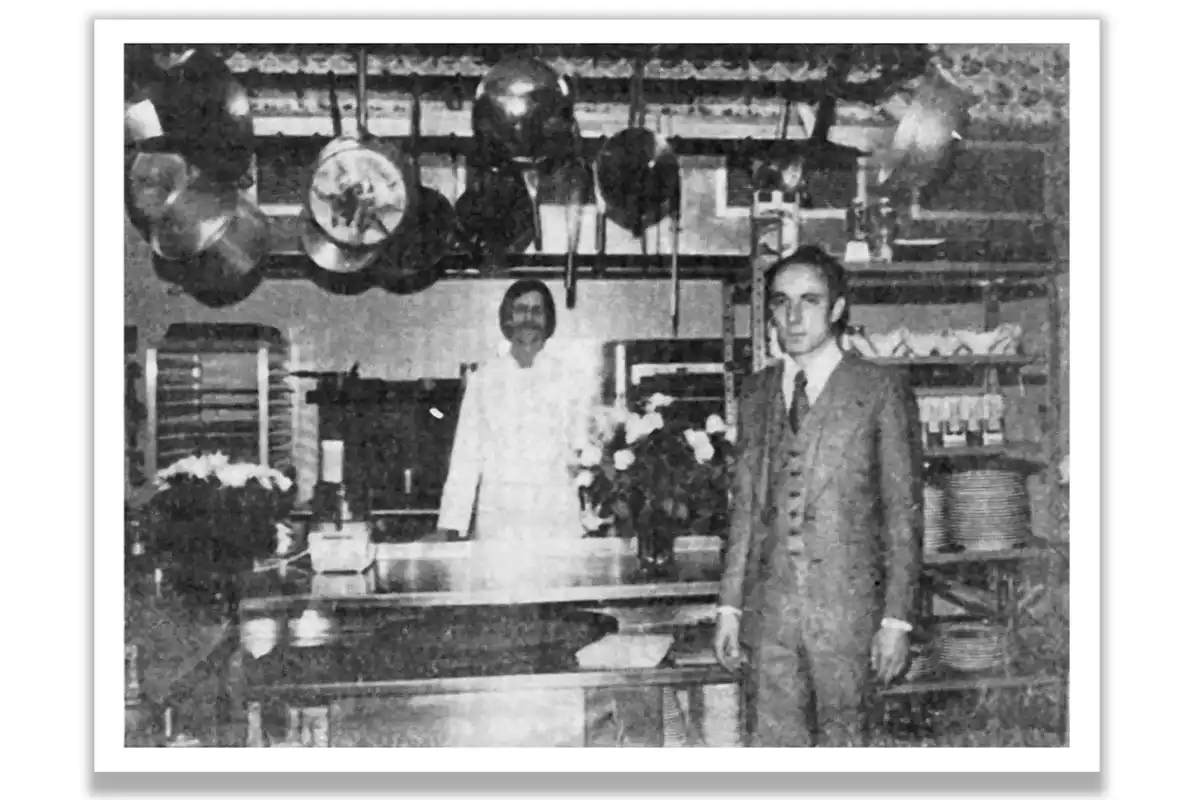
(Courtesy The Inn at Little Washington)
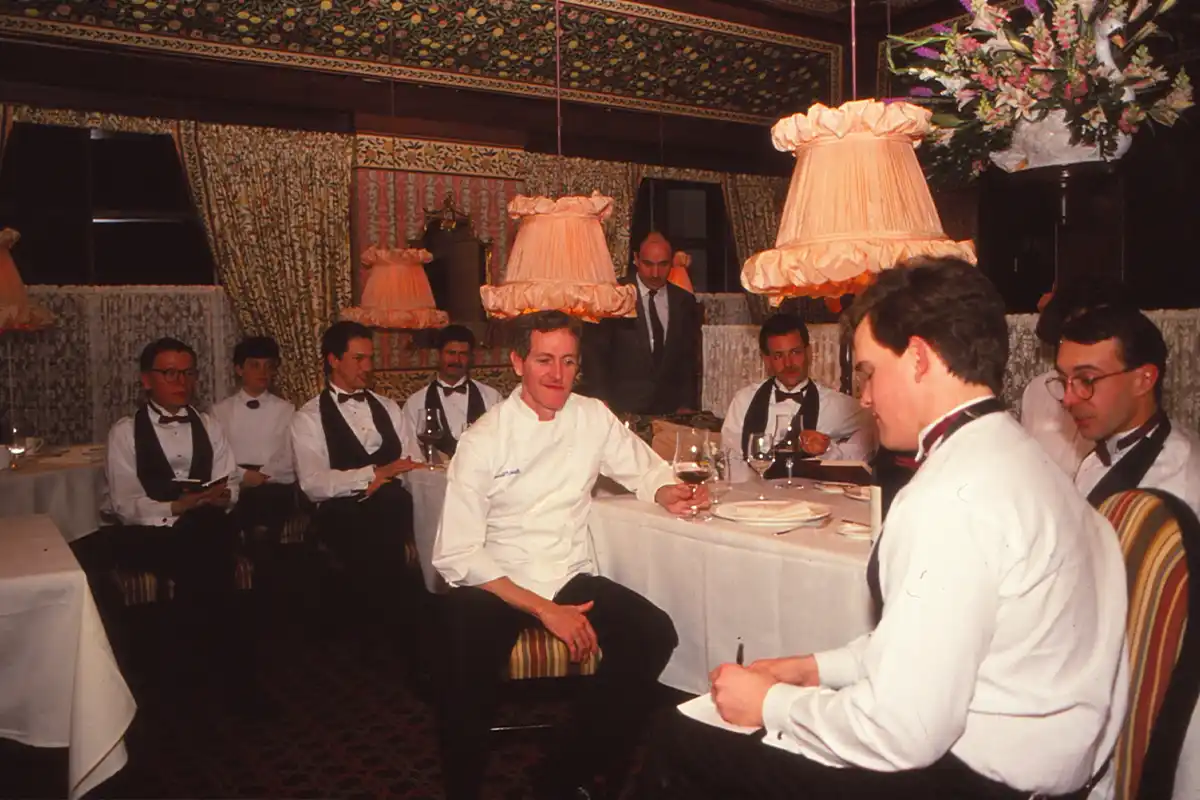
He and his then-partner in life and business, Reinhardt Lynch, had intended to cook and serve customers themselves. But soon, O’Connell was scrambling to find help in the remote town of 125 people. “Most of our early staff had never been inside a restaurant,” he says.
The townspeople, who asked, “Who’s coming?” when the restaurant opened, were surprised to see how far guests were willing to travel to get to The Inn and wait in line on the porch. “It was just very unexpected and improbable that somebody would try to open an ambitious restaurant out here. … It was a town of three gas stations, lost in time.”
(Courtesy The Inn at Little Washington)
O’Connell bought out Lynch’s part of the business in 2007 and has been the sole proprietor ever since. He’s bought and renovated many of the buildings in town, expanding the footprint of The Inn.
O’Connell has shaped his own world in little Washington, complete with idyllic gardens, cottages, shops, and a more casual eatery called Patty O’s.
Finding Flawlessness
In this world, O’Connell has trained his staff to be as meticulous as he is.
“The one thing about a great, great restaurant is it has a sense of immaculateness. You have to work very hard to find a scratch or a flaw or an imperfection. And it’s like every day they’re on. Everything is perfect and fresh — the flowers are gorgeous and you just feel privileged that there is such a place in the world where no expense is spared.”
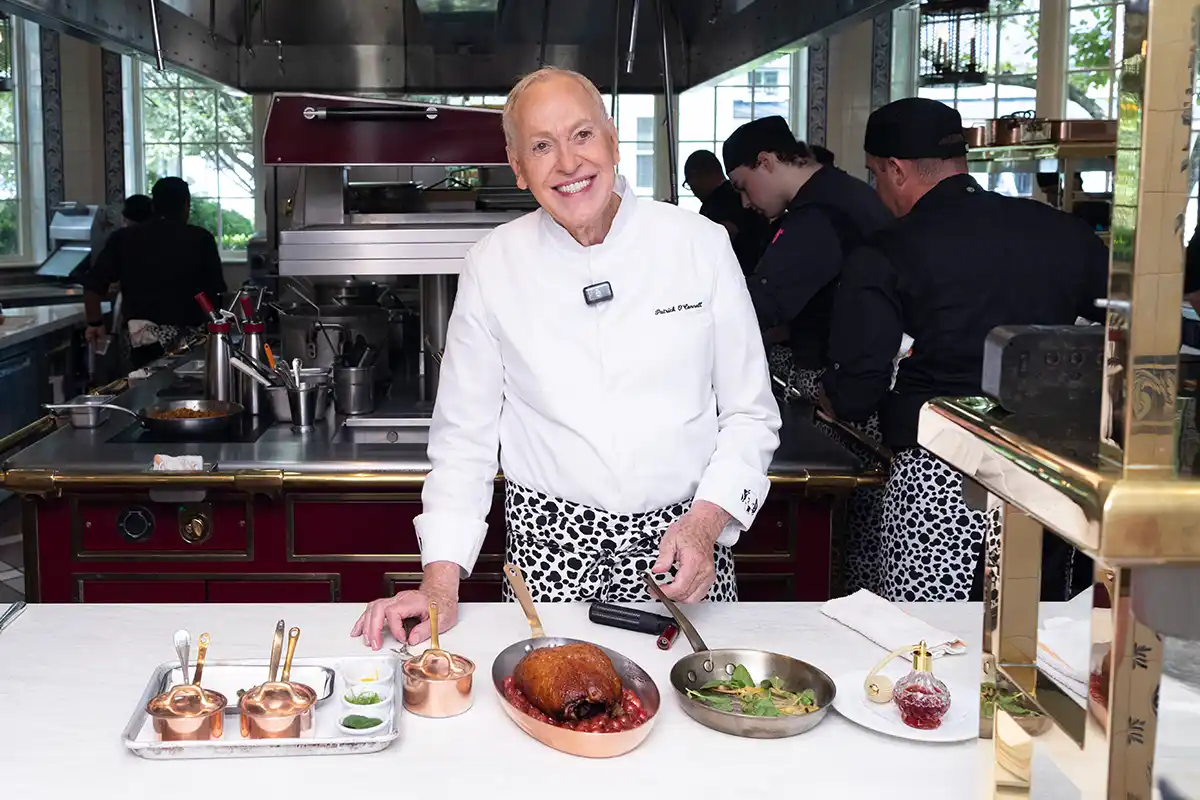
When we visited The Inn this summer to interview O’Connell, as we walked the grounds, staff members would stop to snap photos of any minor flaws they spotted so they could text other employees and get the issue resolved. They called the kitchen to get food on a table if “Chef” was going to be seated there for a photo shoot. They ensured his go-to drink, The Inn’s iced tea, was ready for him (with lemon and served in one of his preferred glasses). They knew exactly where O’Connell would want to sit for his interview, and everyone knew to keep that area reserved for his use.
They anticipated our needs, too, guiding us around the property and offering us cold drinks. O’Connell did the same himself as soon as he arrived.
It’s all emblematic of The Inn’s high level of service and pristine attention to detail.
Pushing the Envelope
O’Connell describes his pursuit of The Inn’s third Michelin star, which it received in 2019 after falling short the year before: “There’s a momentum in achieving something, in going for the goal. All of your energy is thrown toward it, and there’s a great camaraderie among the team: ‘We want to do this. We’re going to do this.’ And there’s a great exhilaration, of course, in achieving it,” he says. “And then there is the, Oh my God. Now we have to maintain it.”
And how does he go about maintaining it? “You don’t just maintain it by staying the same. You reinvent. You end up competing with yourself very often, and that’s very hard. When you get to a certain level, exceeding that is very, very challenging. Getting to that level requires a kind of superhuman energy, sometimes, and motivation, a lot of sacrifice, but then it’s like — ‘Umm, that’s not good enough.’”

(Courtesy The Inn at Little Washington)
O’Connell says The Inn is “continually pushing the envelope” while still maintaining a continuum and never chasing trends.
“That’s been one of the hallmarks of our success,” he says. “I love it when [guests] say, ‘We were here in ’87, did you change something?’ … But what they mean is the experience was just as wonderful. We haven’t veered off. We’ve stayed the course.”
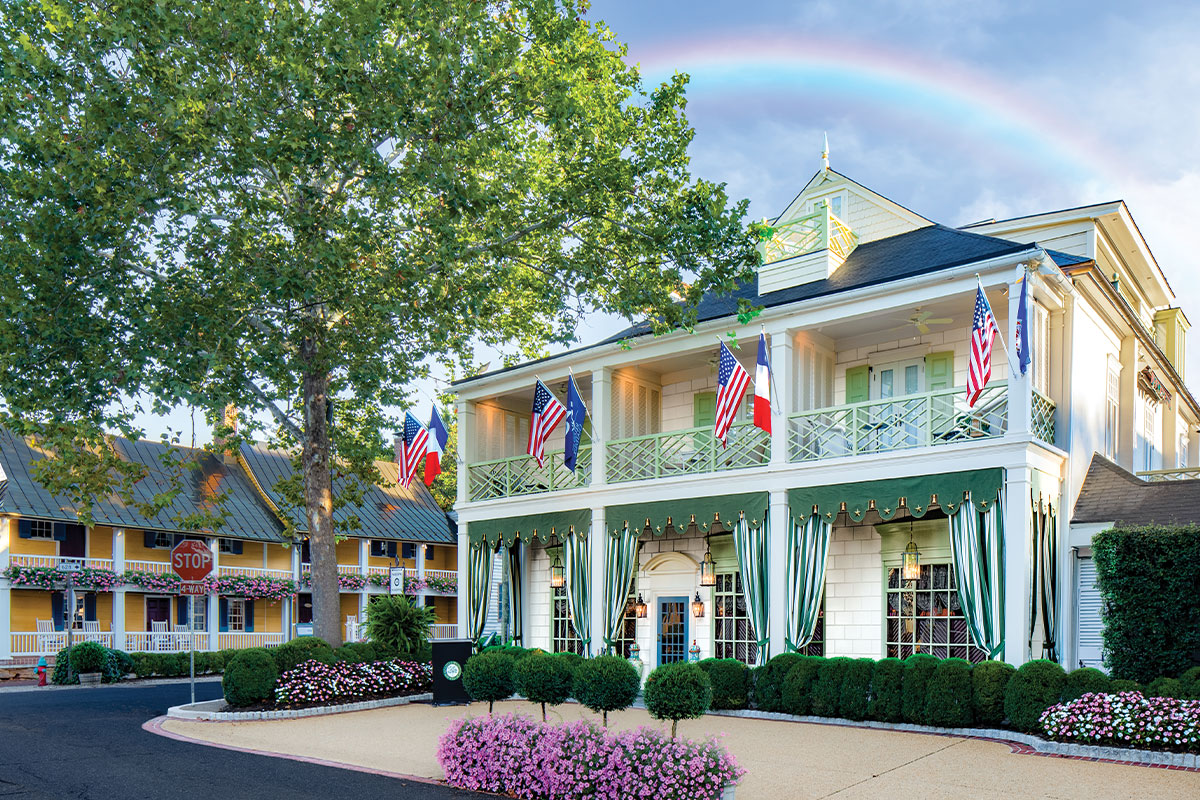
There always seems to be a new project going on at The Inn. But as O’Connell describes, each addition is seamless.
One staff member recalls the day that the new glass conservatory was opened, after The Inn had used a tent to create outdoor seating during the COVID-19 pandemic. Some locals stopped in to ask O’Connell about where the “new room” was — while they were standing in it. It had been crafted to look like it had always been a part of The Inn.
Creating a Legacy
O’Connell has received many accolades later in his career, including a Lifetime Achievement Award from the James Beard Foundation, a National Humanities Medal from President Donald Trump, and an Honorary Doctorate Degree in the Culinary Arts from Johnson & Wales University.
At The Inn at Little Washington, many of the guest rooms are named after culinary pioneers who stayed in them (including Julia Child, for example). In a culture where chefs weren’t revered when he was starting out in the restaurant business, O’Connell wants to make sure America’s culinary history isn’t lost on generations to come.
“I wanted to kind of impart the idea that this was not just any old inn, but it was a mecca for people who loved good food, who revered good food, who were part of a movement to bring America to the point it is at now, where it may be one of the most important food cultures anywhere in the world. And that happened quickly, very fast,” he says.
He’s now focused on writing a memoir to share his remarkable story. And The Inn is already planning its 50th anniversary celebrations for 2028.
“I think what is unique about my own situation is I went from a period when we didn’t have a food culture in this country, to observing and participating in every decade — as in the last 50 years — that brought us to the pinnacle of where we are now. So I was in the movie before the movie had a name. And keeping that history alive, I think, is very important.”
The Meal of a Lifetime
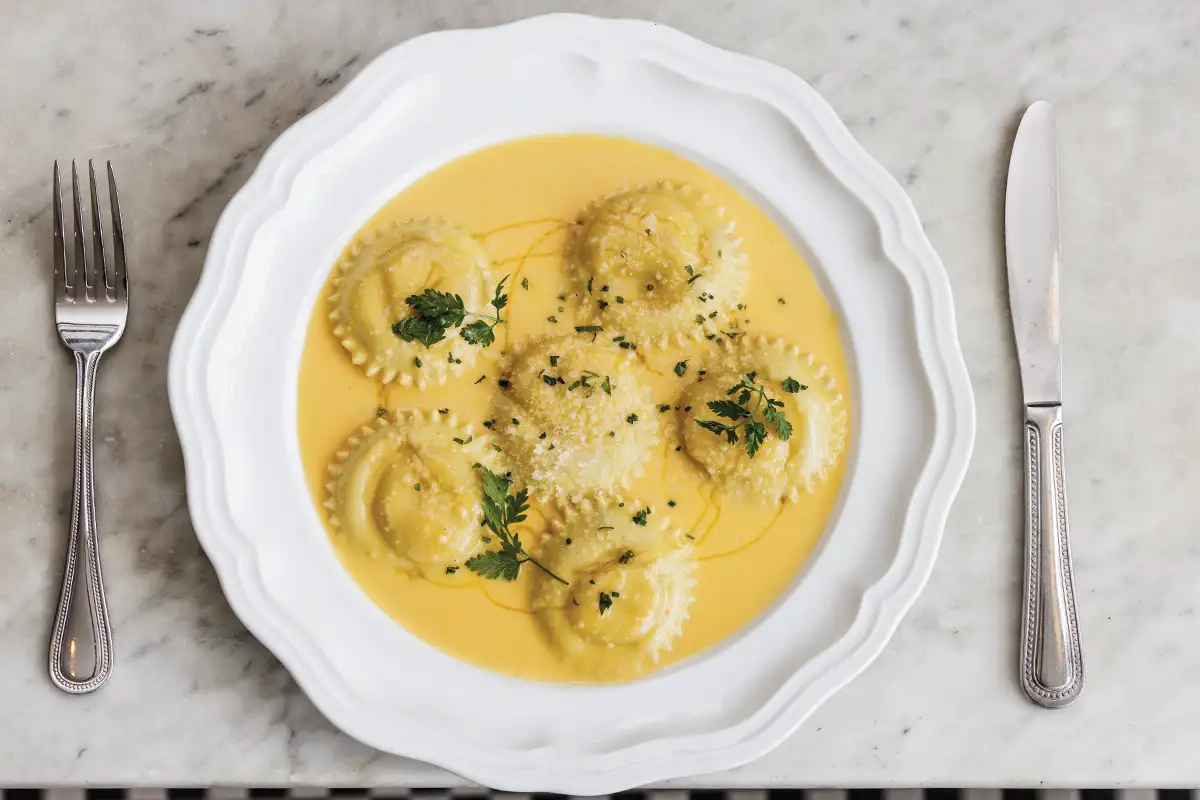
Today, a meal at The Inn at Little Washington costs $388 per person, but O’Connell believes people should see it as an immersive experience and a memory that will last a lifetime.
“Good food is good food, and it’s wonderful in isolation, but when you put it together with a whole feeling of beauty and luxury, serenity and flawlessness, it’s enhanced further. … They say that on your deathbed, there’s a moment when you reflect on the greatest meal of your life. So if you haven’t had it, you’re depriving yourself,” he laughs.
“I believe that what we do is parallel to any kind of artistic expression. So it has to represent the artist. It has to be authentic to the artist. We can’t do something that I don’t like. We can’t put up a dish that I don’t find delicious,” O’Connell says.
And at the end of the day, he says, it’s all about loving and believing in what you do.
“I have to love what I’m doing in order for the guest to feel that. That it’s communicated that we’re not doing it because it’s cool; it’s what I believe in. The feeling here is what I believe in, what I would like to find when I went somewhere, what I would like to discover — the kind of oasis that I would hope to find in the world.”
Honoring a Legend
Northern Virginia Magazine will present Chef Patrick O’Connell with a lifetime Achievement Award during its Taste of NoVA event on Sunday, October 12.
Feature image of Patrick O’Connell by Michael Butcher
This story originally ran in our October issue. For more stories like this, subscribe to Northern Virginia Magazine.